

Cerium (III) Nitrate Hexahydrate
Properties
- We can offer items in bulk or custom. For other quantities or purities, please request a quotation.
- All prices are subject to change.
Related Products
Information about Cerium (III) Nitrate Hexahydrate / CAS 10294-41-4
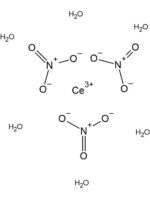
Cerium (III) Nitrate hexahydrate (Ce(NO3)3.6H2O) is a colorless, water-soluble salt. Like Cerium (III) Acetate, Ce(NO3)3 has a water solubility that makes it an effective Cerium precursor for synthesizing Cerium-containing materials, and its redox activity makes it suitable as a catalyst. Its relatively low decomposition temperature of 300 °C leads to the formation of Cerium Oxide (Ceria, CeO₂), enabling its use in the preparation of Cerium Oxide–based materials. In addition, recent developments have noted its anti-microbial activity in wound treatments, especially for burns.
Like Cerium (III) Acetate, Cerium (III) Nitrate hexahydrate is widely used to prepare Ceria-based (CeO₂) materials. Its high water solubility facilitates homogeneous incorporation into materials and enables synthesis via sol-gel or precipitation methods. Researchers at the A. A. Baikov Institute of Metallurgy and Materials Science demonstrated that Ceria can be efficiently produced from Cerium Nitrate using the sol-gel method. Ceria powders are widely employed as precision polishing abrasives, and a patent by Anji Microelectronics Technology (Shanghai, China) identifies Cerous Nitrate as the preferred precursor for such applications. Cerium salts also serve as dopants in anti-corrosion coatings; for example, epoxy coatings doped with Cerium Nitrate, as reported by researchers at Dalian University of Technology, exhibit enhanced self-healing and chemical resistance. In addition, cerium oxide nanoparticles produced via precipitation methods can be incorporated into hydrogels, films, 3D-printed dressings, and electrospun fibers to promote wound healing, particularly for burns. These nanoparticles possess antibacterial, anti-inflammatory, antioxidant, and angiogenic properties, making them effective for accelerating tissue regeneration and preventing infection.
Ceria-based catalysts are also well-known automotive three-way catalysts. They remove pollutants produced from gasoline combustion. Ceria is considered the best catalysts for soot combustion. Like other Cerium-based materials, Cerium (III) nitrate is useful in the synthesis of Ceria-based catalysts. For example, researchers from the Autonomous Metropolitan University, Iztapalapa Unit in Mexico City, Mexico were able to synthesize an Aluminum Oxide-Cerium Oxide (Alumina-Ceria) catalyst by impregnating high-purity boehmite (Aluminum Oxide Hydroxide mineral) with Cerous Nitrate hexahydrate, followed by heat treatment under air. The materials successfully catalyzed the combustion of toluene in air, with the higher concentrations of Ce4+ versus Ce3+ leading to higher combustion activity.
- Vratny, F., Kern, S., & Gugliotta, F. (1961). The thermal decomposition of cerium (III) nitrate hydrate. Journal of Inorganic and Nuclear Chemistry, 17(3–4), 281–285. https://doi.org/10.1016/0022-1902(61)80152-8
- Zagaynov, I. v., & Kutsev, S. v. (2014). Formation of mesoporous nanocrystalline ceria from cerium nitrate, acetate or acetylacetonate. Applied Nanoscience (Switzerland), 4(3), 339–345. https://doi.org/10.1007/S13204-013-0210-4
- Spherical cerium carbonate and synthesis method of cerium oxide (CN113120940A). (2019). https://patents.google.com/patent/CN113120940A/en
- Butt, A. M., Wang, Y., Ma, H., & Li, H. (2023). The preparation of cerium nitrate and attapulgite based superhydrophobic epoxy coatings for the corrosion protection of Q355 mild steel surface. Surface and Coatings Technology, 473, 129977. https://doi.org/10.1016/J.SURFCOAT.2023.129977
- Nosrati, H., Heydari, M., & Khodaei, M. (2023). Cerium oxide nanoparticles: Synthesis methods and applications in wound healing. Materials Today Bio, 23, 100823. https://doi.org/10.1016/J.MTBIO.2023.100823
- Montini, T., Melchionna, M., Monai, M., & Fornasiero, P. (2016). Fundamentals and Catalytic Applications of CeO2-Based Materials. Chemical Reviews, 116(10), 5987–6041. https://doi.org/10.1021/ACS.CHEMREV.5B00603
Safety


- H272May intensify fire; oxidizer.
- H318Causes serious eye damage.
- P210Keep away from heat/sparks/open flames/hot surfaces. — No smoking.
- P220Keep/Store away from clothing/.../combustible materials.
- P221Take any precaution to avoid mixing with combustibles/...
- P280Wear protective gloves/protective clothing/eye protection/face protection.
- P305+P351+P338IF IN EYES: Rinse cautiously with water for several minutes. Remove contact lenses, if present and easy to do. Continue rinsing.
- P310Immediately call a POISON CENTER or doctor/physician.
- P370+P378In case of fire: Use ... for extinction.
Learn about this element
