

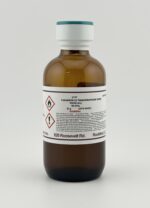
Vanadium (V) Triisopropoxide Oxide
Properties
- We can offer items in bulk or custom. For other quantities or purities, please request a quotation.
- All prices are subject to change.
Information about Vanadium (V) Triisopropoxide Oxide / CAS 5588-84-1
Vanadium (V) Triisopropoxide Oxide, also known as Vanadium Oxytriisopropoxide, is a versatile organovanadium compound widely used as a precursor in the synthesis of Vanadium Oxide materials. Its high reactivity, volatility, and controlled decomposition are important characteristics that make it a useful reagent for thin-film deposition, catalysis, and advanced material synthesis. The compound plays a crucial role in laboratory and research applications requiring high-purity Vanadium Oxide films, nanoparticles, and functional coatings, making it valuable for industries such as electronics, energy storage, catalysis, and photovoltaics.
A primary application of Vanadyl (V) Isopropoxide is in chemical vapor deposition (CVD) and atomic layer deposition (ALD), where it serves as a vanadium oxide precursor. Researchers have successfully used Vanadium (V) Triisopropoxide Oxide to fabricate Vanadium Oxide thin films with controlled morphologies and phase compositions, a critical factor in developing next-generation electronic components and optoelectronic devices. These films exhibit tunable electrical and optical properties, making them ideal for sensors, transistors, and transparent conductive coatings. Additionally, Vanadium Oxide-based films are essential for bolometric detectors, infrared sensors, and thermochromic applications, where phase transitions influence their conductivity and optical behavior.
Vanadium Oxytriisopropoxide is a key precursor for Vanadium-based catalysts in oxidation reactions, including hydrocarbon oxidation (e.g., methanol to formaldehyde), biomass conversion into biofuels, and petrochemical refining processes such as oxidative desulfurization. It also plays a crucial role in sulfuric acid production via the Contact Process, where Vanadium Pentoxide enables SO₂ oxidation. Its high solubility and controlled hydrolysis allow for precise incorporation into catalytic systems, leading to enhanced reaction efficiency and selectivity. The compound is extensively used in the production of Vanadium-containing zeolites and mesoporous materials, which are crucial in industrial-scale catalytic processes.
Energy storage researchers benefit significantly from Vanadium-based materials derived from Vanadyl (V) Isopropoxide. Studies have demonstrated that vanadium oxide coatings improve Lithium-ion battery performance by enhancing electrode stability and charge-discharge efficiency. In supercapacitors, Vanadium Oxide nanoparticles contribute to high energy density and rapid charge storage capabilities, making them essential for next-generation energy storage solutions. Moreover, Vanadium Oxide thin films serve as hole-selective contact layers in solar cells, improving charge extraction efficiency and reducing recombination losses. This leads to enhanced photovoltaic performance and increased device stability by minimizing interface degradation.
- C. S. Hwang and C. Y. Yoo (eds.), Atomic Layer Deposition for Semiconductors, Springer Science+Business Media New York 2014 https://doi.org/10.1007/978-1-4614-8054-9_1
- Klett, U., & Fricke, J. (1998). Gelation of vanadium (V) oxide-triisopropoxide doped silica gels. Journal of non-crystalline solids, 238(1-2), 45-50. https://doi.org/10.1016/S0022-3093(98)00575-4
Kumar, S., Lenoble, D., Maury, F., & Bahlawane, N. (2015). Synthesis of vanadium oxide films with controlled morphologies: Impact on the metal–insulator transition behaviour. physica status solidi (a), 212(7), 1582-1587. https://doi.org/10.1002/pssa.201532325
Safety


- H226Flammable liquid and vapor.
- H315Causes skin irritation.
- H319Causes serious eye irritation.
- H335May cause respiratory irritation.
- P210Keep away from heat/sparks/open flames/hot surfaces. — No smoking.
- P233Keep container tightly closed.
- P240Ground/bond container and receiving equipment.
- P241Use explosion-proof electrical/ventilating/lighting/.../equipment.
- P242Use only non-sparking tools.
- P243Take precautionary measures against static discharge.
- P261Avoid breathing dust/fume/gas/mist/vapours/spray.
- P264Wash skin thoroughly after handling.
- P271Use only outdoors or in a well-ventilated area.
- P280Wear protective gloves/protective clothing/eye protection/face protection.
- P303+P361+P353IF ON SKIN (or hair): Remove/Take off Immediately all contaminated clothing. Rinse SKIN with water/shower.
- P304+P340IF INHALED: Remove victim to fresh air and Keep at rest in a position comfortable for breathing.
- P305+P351+P338IF IN EYES: Rinse cautiously with water for several minutes. Remove contact lenses, if present and easy to do. Continue rinsing.
- P312Call a POISON CENTER or doctor/physician if you feel unwell.
- P362Take off contaminated clothing and wash before reuse.
- P370+P378In case of fire: Use ... for extinction.
- P403+P233Store in a well-ventilated place. Keep container tightly closed.