
Antimony (III) Butoxide
Properties

- We can offer items in bulk or custom. For other quantities or purities, please request a quotation.
- All prices are subject to change.
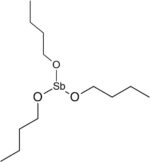
Information about Antimony (III) Butoxide / CAS 2155-74-0
Antimony (III) Butoxide is a liquid at room temperature. Like other alkoxides, it readily hydrolyzes in water and is therefore quite air sensitive. However, because it readily decomposes to Antimony (III) Oxide (Sb2O3), it makes it a facile reagent for the preparation of Antimony Oxides, or other metal oxides doped with Antimony.
For example, researchers from the Universities of Bath and Keel in the United Kingdom underwent a comprehensive study comparing several Antimony alkoxides for their use in the metal-organic chemical vapor deposition of Antimony Oxide thin films. Their objective was to prepare quality films of senarmontite with carefully controlled microstructure for use in gas sensing applications. While they performed several experiments with Antimony (III) Ethoxide, two experiments were also performed with Antimony (III) Butoxide. In one of them, they obtained senarmontite (Sb2O3) with very small grain sizes.
Antimony (III) Butoxide can also be used in sol-gel synthesis. Researchers from the University of Limerick, Ireland used a variety of metal alkoxides to dope Zinc Oxide for use as an electrical varistor, which protects delicate electrical components from excessive voltage. For the Antimony-doped material, they first prepared a solution of Zinc Acetylacetonate dissolved in benzyl alcohol. They then slowly added the Antimony Butoxide. After evaporating the solvent, the powders were calcined, ground in a ball mill, and then sintered to obtain the final material.
Antimony (III) Butoxide can also be used to prepare metal oxide catalysts. For example, researchers from the Catholic University of Louvain in Belgium wanted to prepare ferric molybdate impregnated with small quantities of Antimony trioxide. The obtained powders needed to be finely interdispersed to facilitate the movement of oxygen in the material to catalyze the oxidation of isobutene to methacrolein. To achieve this, they treated the ferric molybdate support with a solution of Antimony Butoxide in isobutanol, and then adding water to form a gel. The solvent was removed and the material was dried and calcined. The material was tested in a fixed bed reactor. The Antimony-doped support exhibited dramatically improved catalytic activity than the non-doped material.
References
- Myers, C. P., Haycock, P. W., Pichot, M., Horley, G. A., Molloy, K. C., Rushworth, S. A., & Smith, L. M. (2004). Deposition of antimony and antimony oxides by MOCVD.(opens in new tab) Chemical Vapor Deposition, 10(1), 35–44. https://doi.org/10.1002/CVDE.200306267
- Puyané, R., Toal, F., & Hampshire, S. (1996). Production of doped ZnO powders for varistor applications using sol-gel techniques.(opens in new tab) Journal of Sol-Gel Science and Technology, 6(3), 219–225. https://doi.org/10.1007/BF00402692
- Xiong, Y. L., Weng, L. T., Zhou, B., Yasse, B., Sham, E., Daza, L., Gillambias, F., Ruiz, P., & Delmon, B. (1991). Preparation of Oxidation Catalysts with a Controlled Architecture. Studies in Surface Science and Catalysis(opens in new tab), 63(C), 537–546. https://doi.org/10.1016/S0167-2991(08)64616-9
Safety
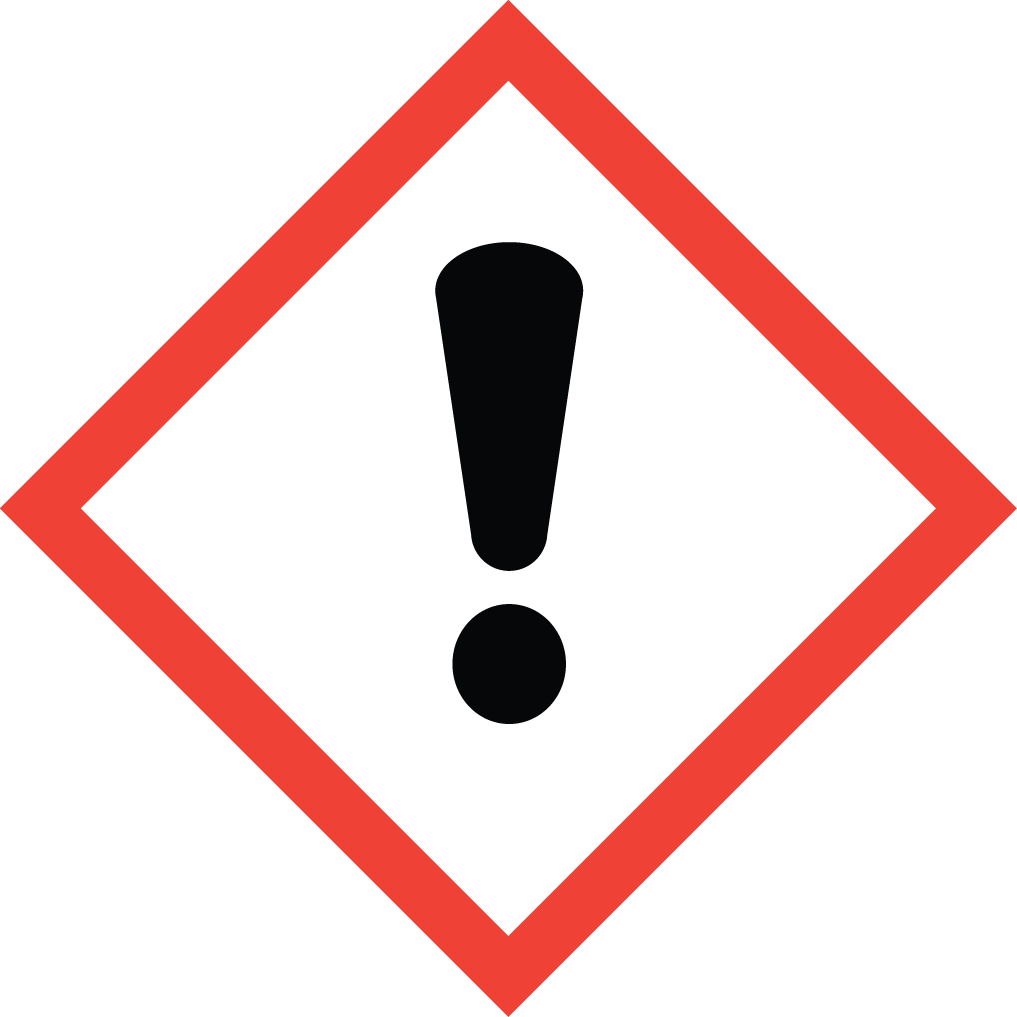
- H302+H332Harmful if swallowed or if inhaled.
- P273Avoid release to the environment.