

Boron Oxide
Properties

- We can offer items in bulk or custom. For other quantities or purities, please request a quotation.
- All prices are subject to change.
Related Products
Information about Boron Oxide / CAS 1303-86-2
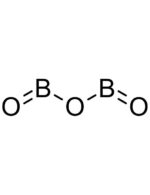
Boron Oxide (B2O3) goes by many names, including Boron trioxide, diboron trioxide, Boria, and Boric Oxide. It is a colorless, hygroscopic, amorphous solid. The amorphous form is the most common. The alpha and beta crystalline structures are only formed at extreme, elevated pressures. It is used in a wide variety of glasses and glazes, particularly borosilicate glass. Borosilicate glasses have a low coefficient of thermal expansion and excellent chemical resistance, making them ideal for kitchen ovenware and lab glassware.
Beyond its conventional use in borosilicate glasses, Boron Oxide (B₂O₃) has been increasingly incorporated into alternative glass systems to impart functional properties for advanced technological applications. For example, TeO₂–Bi₂O₃–B₂O₃ glass systems have attracted considerable interest as non-linear optical materials due to their favorable optical characteristics. In addition, Boron Oxide B₂O₃-containing bioactive glasses have demonstrated significant potential for biomedical applications. A representative bioactive glass composed of Na₂O, K₂O, MgO, CaO, SrO, B₂O₃, SiO₂, and P₂O₅ exhibited low cytotoxicity and promoted apatite formation under physiological conditions, indicating excellent bioactivity and suitability for bone tissue engineering applications.
References
- Tasheva, T. R., & Dimitrov, V. v. (2017). Synthesis, structure and nonlinear optical properties of tellurium oxide-bismuth oxide-boron oxide glasses. Bulgarian Chemical Communications, 49, 43–48.
- Taj S., M., Devaraja, C., & Deka, U. (2025). A review of boron oxide glasses infused with individual oxides of lanthanide elements: For their physical, structural, optical, and gamma shielding properties. Journal of Alloys and Compounds, 1010, 178279. https://doi.org/10.1016/J.JALLCOM.2024.178279
- Pradell, T., & Molera, J. (2020). Ceramic technology. How to characterise ceramic glazes. Archaeological and Anthropological Sciences 2020 12:8, 12(8), 189-. https://doi.org/10.1007/S12520-020-01136-9
- Pan, H. B., Zhao, X. L., Zhang, X., Zhang, K. B., Li, L. C., Li, Z. Y., Lam, W. M., Lu, W. W., Wang, D. P., Huang, W. H., Lin, K. L., & Chang, J. (2009). Strontium borate glass: potential biomaterial for bone regeneration. Journal of the Royal Society Interface, 7(48), 1025. https://doi.org/10.1098/RSIF.2009.0504
Safety

- H360May damage fertility or the unborn child.
- P280Wear protective gloves/protective clothing/eye protection/face protection.
- P308+P313IF exposed or concerned: Get medical advice/attention.
- P501Dispose of contents/container to.....