

Ammonium Tetrathiomolybdate
Properties
- We can offer items in bulk or custom. For other quantities or purities, please request a quotation.
- All prices are subject to change.
Related Products
Information about Ammonium Tetrathiomolybdate / CAS 15060-55-6
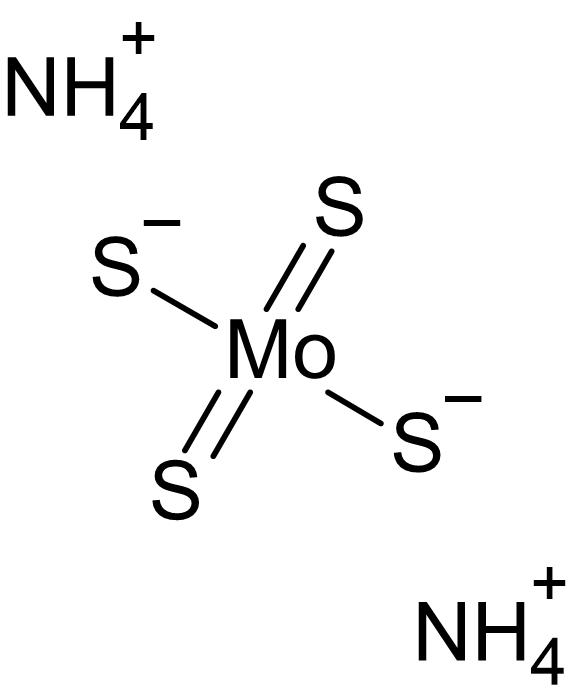
Ammonium Tetrathiomolybdate (ATTM) is an inorganic compound recognized for its distinctive red crystalline structure and unique molybdenum-sulfur cluster structure. As a sulfur-rich molybdenum complex, ATTM plays a significant role in catalysis, materials science, and inorganic synthesis.
ATTM is a moisture-sensitive compound that dissolves in water and several organic solvents, enabling its integration into various chemical processes. It exhibits thermal instability, which is advantageous in applications such as chemical vapor deposition (CVD) and thin-film synthesis. Upon thermal decomposition, ATTM releases Ammonia (NH₃) and Hydrogen Sulfide (H₂S), facilitating the formation of Molybdenum Trisulfide (MoS₃), which further converts into Molybdenum Disulfide (MoS₂) at higher temperatures. These MoS2 thin films are integral to energy storage devices, including batteries and supercapacitors, as well as corrosion-resistant coatings for industrial applications. The ability to deposit uniform, high-quality MoS₂ films using ATTM precursors has propelled research in sustainable energy solutions and next-generation electronics.
ATTM can be used as a precursor for MoS₂-based catalysts, which are widely utilized in the petrochemical industry. These catalysts are integral to hydrodesulfurization (HDS), a critical process for removing sulfur impurities from crude oil-derived fuels. By reducing sulfur content, MoS₂ catalysts contribute to producing cleaner fuels that comply with stringent environmental regulations. Additionally, MoS₂ catalysts support hydrodenitrogenation (HDN), effectively minimizing nitrogen-containing compounds in fuels to enhance their quality and combustion efficiency.
Ammonium Tetrathiomolybdate is widely employed in inorganic synthesis for constructing sulfur-rich transition metal complexes. These complexes exhibit promising electronic, optical, and catalytic properties, making them relevant in material science and nanotechnology research. Researchers use ATTM in the synthesis of metal-sulfur clusters, which have potential applications in energy storage, catalysis, and semiconductor development.
- Vinoba, M., Navvamani, R., & Al-Sheeha, H. (2019). Controllable thermal conversion of thiomolybdate to active few-layer MoS2 on alumina for efficient hydrodesulfurization. SN Applied Sciences, 1(4), 340.
- Le Bihan, L., Mauchaussé, C., Payen, E., & Grimblot, J. (1999). Use of ammonium tetrathiomolybdate as a new precursor for the preparation of hydrodesulfurization catalysts by a sol-gel method. In Studies in surface science and catalysis (Vol. 127, pp. 105-112). Elsevier.