

Dysprosium (III) Acetate Tetrahydrate
Properties
- We can offer items in bulk or custom. For other quantities or purities, please request a quotation.
- All prices are subject to change.
Related Products
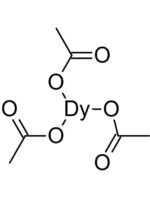
Information about Dysprosium (III) Acetate Tetrahydrate / CAS 15280-55-4
Dysprosium (III) Acetate tetrahydrate is a water-soluble Dysprosium precursor. Due to unpaired electrons in its f-orbital, the trivalent Dysprosium ion is magnetically active and when excited by UV light emits visible light in the blue and yellow regions. Therefore, Dysprosium Acetate is used to prepare magnetic and luminescent materials such as magneto-calorics, single-molecule magnets, and phosphors for lighting. Dysprosium Acetate also decomposes upon heating to Dysprosium Oxide above 600° Celsius, making it suitable as a precursor for Dysprosium-containing oxides.
For example, researchers from the University of Zaragoza in Spain have demonstrated that large single crystals of Dysprosium (III) Acetate tetrahydrate exhibited a magneto-caloric effect when rotated in a magnetic field. The asymmetry of the crystal structure causes the crystal to me magnetically anisotropic, meaning that it is easier to magnetize along one crystallographic direction than another. As the crystal is rotated in a constant applied magnetic field, the crystal decreases in temperature due to the change in magnetic entropy. Magnetocaloric materials such as this can be used for cooling below cryogenic temperatures.
In another example, researchers from Iowa State University used Dysprosium (III) Acetate tetrahydrate to synthesize phosphors for use in white light-emitting diodes. The synthesis involved preparing nanoparticles from a solution of Lanthanum Acetate, Dysprosium Acetate, Thulium Acetate dissolved in ethylene glycol and a tetrafluoroborate-containing ionic liquid. After brief microwave irradiation and thorough washing, a fine powder of Lanthanum Fluoride doped with Dysprosium and Thulium was obtained. The solubility of the lanthanide acetate hydrates facilitated the speeds of the preparation and homogeneity of the final product. Materials with various levels of Dysprosium and Thulium doping were tested to demonstrate the tunability of the emission color by tailoring their concentration.
References
- Hussein, G. A. M., Kroenke, W. J., Goda, B., & Miyaji, K. (1997). Formation of dysprosium oxide from the thermal decomposition of hydrated dysprosium acetate and oxalate Thermoanalytical and microscopic studies. Journal of Analytical and Applied Pyrolysis, 39(1), 35–51. https://doi.org/10.1016/S0165-2370(96)00961-8
- Lorusso, G., Roubeau, O., & Evangelisti, M. (2016). Rotating Magnetocaloric Effect in an Anisotropic Molecular Dimer. Angewandte Chemie, 128(10), 3421–3424. https://doi.org/10.1002/ANGE.201510468
- Hołyńska, M. (2018). Introduction to Single-Molecule Magnets. Single-Molecule Magnets: Molecular Architectures and Building Blocks for Spintronics, 1–39. https://doi.org/10.1002/9783527809929.CH1
- Lorbeer, C., & Mudring, A. V. (2013). Ionic liquid-assisted route to nanocrystalline single-phase phosphors for white light-emitting diodes. ChemSusChem, 6(12), 2382–2387. https://doi.org/10.1002/CSSC.201200915
Safety
Learn about this element
