

Erbium (III) Oxalate Decahydrate
Properties
- We can offer items in bulk or custom. For other quantities or purities, please request a quotation.
- All prices are subject to change.
Information about Erbium (III) Oxalate Decahydrate / CAS 30618-31-6
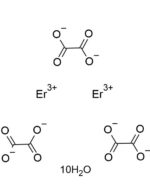
Erbium (III) Oxalate decahydrate (Er₂(C₂O₄)₃.10H2O) is a pink solid that is insoluble in water. Like Erbium (III) Carbonate, it is thermally stable; however, its complete conversion to Erbium (III) Oxide (Er₂O₃) occurs at a higher temperature, above 600 °C. This thermal stability, combined with its insolubility, makes erbium oxalate a useful precursor for the preparation of other erbium-containing materials, including oxides used in advanced technologies.
Erbium is widely employed as a dopant in optical and laser technologies. In fiber optic amplifiers, Er³⁺ ions amplify light signals, which is essential for telecommunications. In laser applications, particularly erbium-doped yttrium aluminum garnet (Er:YAG) lasers, the emission wavelength of erbium is strongly absorbed by water, making these lasers highly effective for medical procedures such as skin resurfacing, dental treatments, and other precise energy applications. Additionally, Erbium acts as a neutron absorber, making Erbium-containing materials useful for nuclear shielding and control applications. Beyond high-tech applications, erbium compounds serve as colorants in glass, ceramics, and porcelain glazes, imparting pink to reddish hues.
The combination of high thermal stability (Carbonate and Oxalate), chemical reactivity, and solubility (Acetate) makes Erbium compounds versatile precursors for materials science, medical technologies, and advanced manufacturing, allowing the creation of materials with tailored optical, magnetic, and electronic properties.
- Balboul, B. A. A. (2000). Thermal decomposition study of erbium oxalate hexahydrate. Thermochimica Acta, 351(1–2), 55–60. https://doi.org/10.1016/S0040-6031(00)00353-1
- el Baiomy, M., Ramadan, R. M., Moustafa, Y. M., & el Damrawi, G. (2024). Exploring the effect of Er2O3 content on the structural, thermal, and physical characteristics of zinc silicate glasses. Materials Chemistry and Physics, 323, 129636. https://doi.org/10.1016/J.MATCHEMPHYS.2024.129636
- Mohsen, M. Y. M., Abdel-Rahman, M. A. E., Saffaa Hassan, M., & Abdelghafar Galahom, A. (2022). Searching for the most optimum burnable absorbers (BAs) for AP-1000 from the neutronic, thermal-hydraulic, and solid mechanics points of view. Nuclear Engineering and Design, 391, 111728. https://doi.org/10.1016/J.NUCENGDES.2022.111728
- Yumeen, S., Hohman, M. H., & Khan, T. (2023). Laser Erbium-Yag Resurfacing. StatPearls. https://www.ncbi.nlm.nih.gov/books/NBK560931/
- Ainslie, B. J. (1991). A Review of the Fabrication and Properties of Erbium-Doped Fibers for Optical Amplifiers. Journal of Lightwave Technology, 9(2), 220–227. https://doi.org/10.1109/50.65880
Safety

- H302Harmful if swallowed.
- H312Harmful in contact with skin.
- P280Wear protective gloves/protective clothing/eye protection/face protection.
- P301+P312IF SWALLOWED: call a POISON CENTER or doctor/physician IF you feel unwell.
- P363Wash contaminated clothing before reuse.
Learn about this element
