
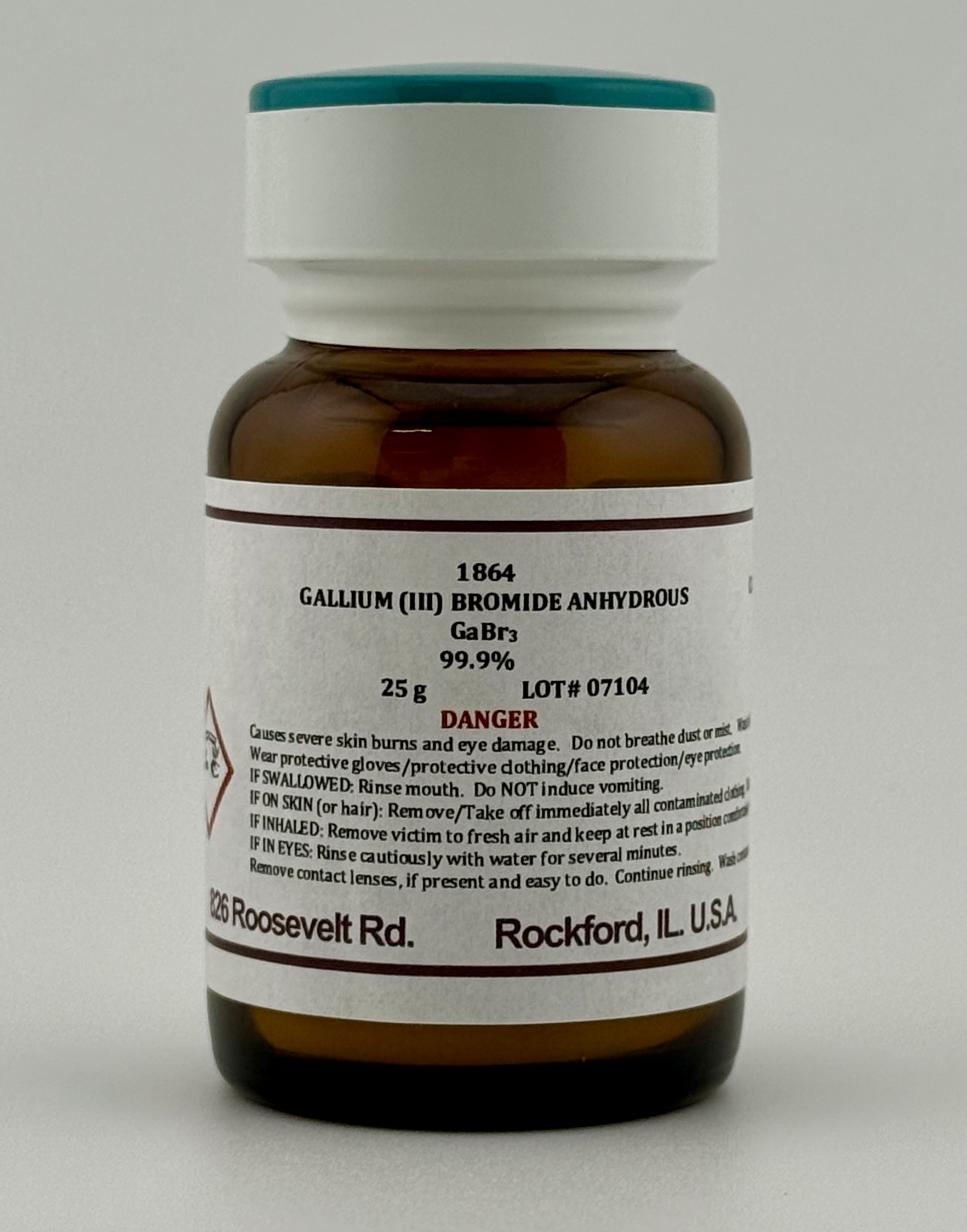
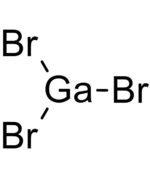
Gallium (III) Bromide, anhydrous
Properties
- We can offer items in bulk or custom. For other quantities or purities, please request a quotation.
- All prices are subject to change.
Related Products
Information about Gallium (III) Bromide, anhydrous / CAS 13450-88-9
Anhydrous Gallium (III) Bromide is a white or slightly yellow crystalline powder. It is extremely moisture sensitive, readily hydrolyzed into Gallium Oxide and Hydrobromic acid. Its reactivity makes it a powerful oxidizing agent and Lewis acid catalyst for various organic chemistry reactions.
For example, researchers from the Carl-von-Ossietzky-University in Oldenburg, Germany studied a variety of metal halide catalysts for activity converting carboxylic acid esters to ethers by silanes. They found that Gallium tribromide effectively catalyzed the reduction of methyl oleate with 1,1,3,3-tetramethylsiloxane (TMDS) to give the methyl oleyl ether and a high molecular polysiloxane. The products were easily separated by short-path distillation.
Gallium (III) Bromide is also a powerful Friedel-Crafts catalyst. Researchers from King’s College in London studied the reactions of Gallium (III) Bromide and Gallium (III) Chloride with substituted aniline to better understand their Lewis Acidity. They concluded that Gallium tribromide and Gallium trichloride have similar acidity and are two of the most powerful Lewis acids to catalyze these kinds of reactions, after Boron trifluoride.
In addition to catalyzing reactions with substituted aniline, Gallium (III) Bromide also catalyzes the reaction of aryl halides with Ethyl bromide to form ethylbenzene. Two chemists from Purdue University in Indiana compared the reactivity of Bromobenzene, Chlorobenzene, and Fluorobenzene to Ethyl bromide in the presence of Gallium (III) Bromide. They found that the relative rate increased with increasing electronegativity of the halogen. The Lewis acidity facilitated the transformation in all studied reactions.
References
Biermann, U., & Metzger, J. O. (2014). Synthesis of ethers by GaBr3-catalyzed reduction of carboxylic acid esters and lactones by siloxanes. ChemSusChem, 7(2), 644–649. https://doi.org/10.1002/CSSC.201300627
Mohammad, A., & Satchell, D. P. N. (1967). Quantitative aspects of Lewis acidity. Part VII. Equilibria between gallium trihalides and aniline bases in ether solution. Journal of the Chemical Society B: Physical Organic, 2, 403–406. https://doi.org/10.1039/J29670000403
Brown, H. C., & Neyens, A. H. (1962). Relative Rates and Isomer Distributions in the Gallium Bromide-Catalyzed Ethylation of the Halobenzenes in Ethylene Dichloride. Partial Rate Factors for the Ethylation Reaction. Journal of the American Chemical Society, 84(9), 1655–1658. https://doi.org/10.1021/JA00868A032
Safety

- H314Causes severe skin burns and eye damage.
- P260Do not breathe dust/fume/gas/mist/vapours/spray.
- P264Wash skin thoroughly after handling.
- P280Wear protective gloves/protective clothing/eye protection/face protection.
- P301+P330+P331IF SWALLOWED: Rinse mouth. Do NOT induce vomiting.
- P303+P361+P353IF ON SKIN (or hair): Remove/Take off Immediately all contaminated clothing. Rinse SKIN with water/shower.
- P304+P340IF INHALED: Remove victim to fresh air and Keep at rest in a position comfortable for breathing.
- P305+P351+P338IF IN EYES: Rinse cautiously with water for several minutes. Remove contact lenses, if present and easy to do. Continue rinsing.
- P363Wash contaminated clothing before reuse.
Learn about this element
