

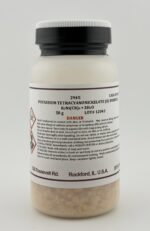
Potassium Tetracyanonickelate (II) Hydrate
Properties
- We can offer items in bulk or custom. For other quantities or purities, please request a quotation.
- All prices are subject to change.
Information about Potassium Tetracyanonickelate (II) Hydrate / CAS 339527-86-5
Dipotassium Nickel Tetracyanide hydrate (K2[Ni(CN)4]) is a yellow-orange, water-soluble coordination compound. The Nickel-cyanide complex forms a square planar structure, which leaves available sites around the Nickel ion for coordination to other species. Potassium Tetracyanonickelate is primarily used as a reagent for other Nickel complexes, as well as a reagent for electroplating.
For example, researchers from the University of Basilicata in Potenza, Italy used Potassium Tetracyanonickelate and Potassium Cyanocuprate(I) as the metal precursors to deposit a Ni-Cu alloy film on gold electrodes in a basic solution containing Sodium Hydroxide. The resulting film electrocatalytically oxidized glucose and demonstrated strong electrochemical stability and longevity in basic media.
Potassium nickel cyanide can also be used as a synthetic precursor to prepare novel cyano complexes. The cyano groups in tetracyanonickelate complexes can act as terminal or bridging ligands, resulting in complex architectures. In a more recent example, researchers from Eskisehir Osmangazi University in Turkey grew crystals of two novel heteropolynuclear complexes. They used Potassium Tetracyanonickelate as a starting reagent in the aqueous synthesis, along with Copper Chloride, Zinc Chloride, Cadmium Chloride, Nickel Chloride, and Potassium Cyanide.
- Casella, I. G., & Gatta, M. (2002). Electrodeposition and Characterization of Nickel-Copper Alloy Films as Electrode Material in Alkaline Media. Journal of The Electrochemical Society, 149(10), B465. https://doi.org/10.1149/1.1504717
- Fernelius, W. C., Burbage, J. J., & Ballou, N. E. (1946). Potassium Tetracyanonickelate(II). Inorganic Syntheses, 227–228. https://doi.org/10.1002/9780470132333.ch73
- Sayin, E., Kürkçüoǧlu, G. S., Yeşilel, O. Z., Hökelek, T., & Büyükgüngör, O. (2014). One- and two-dimensional heteropolynuclear complexes with tetracyanonickelate(II) and 2-pyridinemethanol. Zeitschrift Fur Kristallographie – Crystalline Materials, 229(8), 563–572. https://doi.org/10.1515/zkri-2014-1756ja01476a007
Safety


- H300+H310+H330Fatal if swallowed, in contact with skin, or if inhaled.
- H317May cause an allergic skin reaction.
- H334May cause allergy or asthma symptoms or breathing difficulties if inhaled.
- H350May cause cancer.
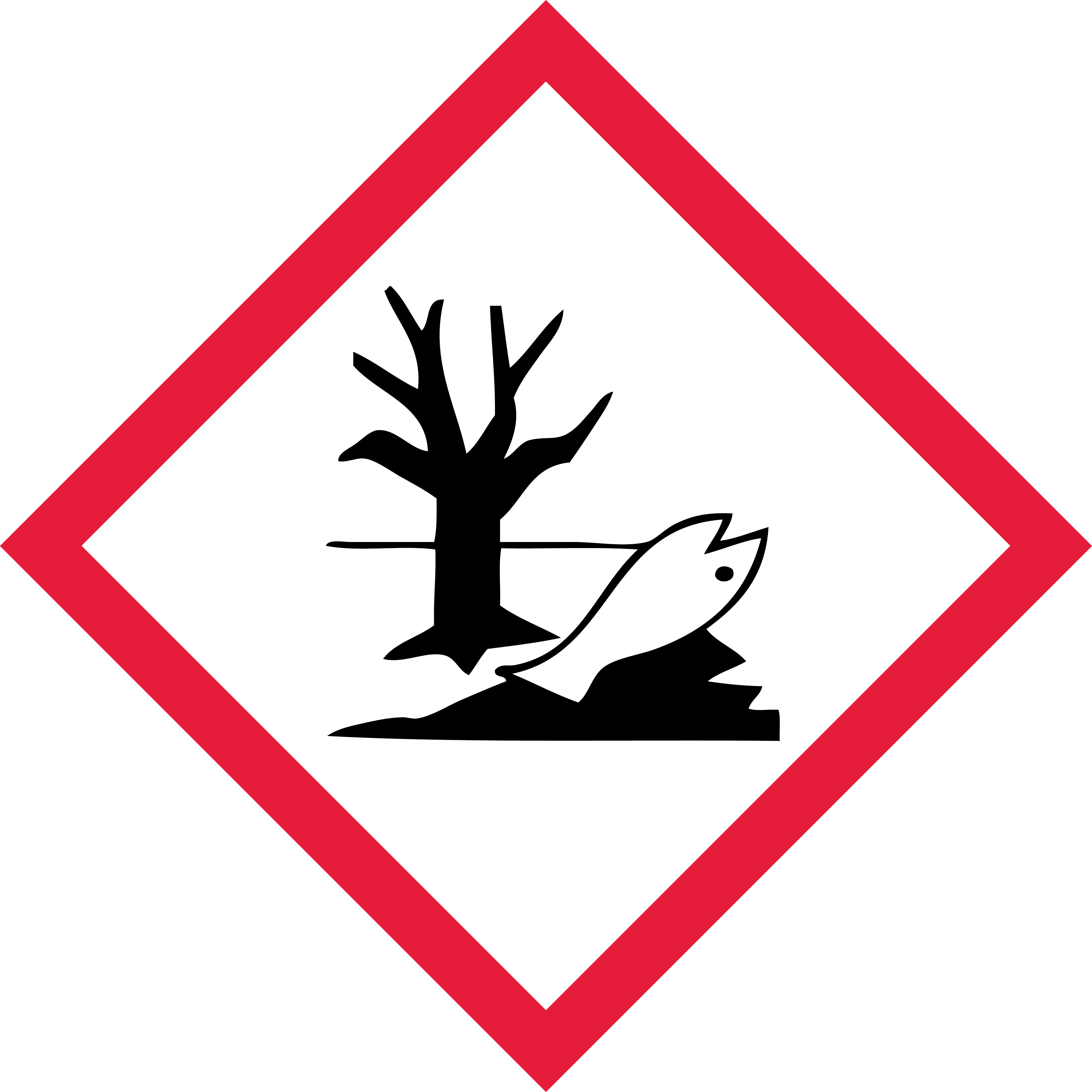
- H410Very toxic to aquatic life with long lasting effects.
- P260Do not breathe dust/fume/gas/mist/vapours/spray.
- P262Do not get in eyes, on skin, or on clothing.
- P264Wash skin thoroughly after handling.
- P270Do not eat, drink or smoke when using this product.
- P271Use only outdoors or in a well-ventilated area.
- P273Avoid release to the environment.
- P280Wear protective gloves/protective clothing/eye protection/face protection.
- P284Wear respiratory protection.
- P301+P310IF SWALLOWED: Immediately call a POISON CENTER or doctor/physician.
- P302+P352IF ON SKIN: wash with plenty of soap and water.
- P304+P340IF INHALED: Remove victim to fresh air and Keep at rest in a position comfortable for breathing.
- P361Remove/Take off immediately all contaminated clothing.
Learn about this element
