

Iron (III) Sulfate Hydrate
Properties
- We can offer items in bulk or custom. For other quantities or purities, please request a quotation.
- All prices are subject to change.
Information about Iron (III) Sulfate Hydrate / CAS 15244-10-7
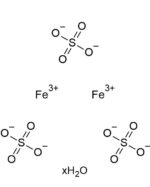
Iron (III) Sulfate hydrate (Ferric Sulfate hydrate, Fe₂(SO₄)₃·XH₂O), is a widely used inorganic compound with applications in chemical synthesis, catalysis, material science, and environmental research. This highly soluble material is a commonly used reagent in industrial and laboratory applications, particularly where iron-based oxidation and precipitation reactions are required. Its role as an oxidizing agent in various chemical processes make it essential for multiple fields.
Iron (III) Sulfate hydrate exhibits oxidizing properties, contributing to its role in redox reactions and catalysis. It dissolves readily in water, forming acidic solutions, which makes it an excellent reagent for pH-sensitive reactions and complex formation. In controlled environments, Iron (III) Sulfate hydrate may undergo thermal decomposition, which could be relevant for certain high-temperature applications such as materials research and reaction mechanism studies. Additionally, its interaction with metal oxides has been explored for developing Iron-based nanostructures in research related to catalysis and electronics.
Ferric Sulfate hydrate is widely used as a precursor for Iron-containing catalysts in organic synthesis. It facilitates oxidation reactions, aromatic ester formation, and other redox processes. In materials chemistry, it aids in controlled metal precipitation and surface modification for catalytic applications. Researchers in inorganic chemistry and synthetic labs use it for developing Iron-based coordination complexes. It also plays a role in advanced synthetic methodologies, including green chemistry applications where iron compounds are explored as potential alternatives to more hazardous metal catalysts.
Safety

- H315Causes skin irritation.
- H319Causes serious eye irritation.
- H335May cause respiratory irritation.
- P261Avoid breathing dust/fume/gas/mist/vapours/spray.
- P305+P351+P338IF IN EYES: Rinse cautiously with water for several minutes. Remove contact lenses, if present and easy to do. Continue rinsing.
- P302+P352IF ON SKIN: wash with plenty of soap and water.
- P501Dispose of contents/container to.....
Learn about this element
