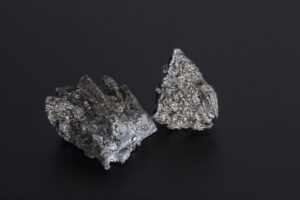
Samarium (III) Carbonate Hydrate
Properties

- We can offer items in bulk or custom. For other quantities or purities, please request a quotation.
- All prices are subject to change.
Related Products
Information about Samarium (III) Carbonate Hydrate / CAS 38245-37-3
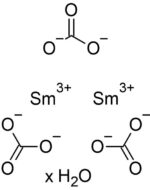
Samarium (III) Carbonate hydrate (Sm2(CO3)3•xH2O) is a white to pale yellow powder, which is insoluble in water. Samarium ions emit light in the red or orange-red region, depending upon oxidation state. Samarium Carbonate reacts with mineral acids to form salts, which can be used as water-soluble precursors. It can also be calcined to form samarium oxide above 700 degrees Celsius. Samarium Oxide has catalytic properties.
Researchers from the Sree Chitra Tirunal Institute in Thiruvananthapuram, India used Samarium Carbonate to prepare luminescent theranostic nanoparticles. Theranostic agents are used for both imaging and targeted drug therapy. They prepared Samarium Chloride by reacting Samarium Carbonate with hydrochloric acid and evaporating the water. A co-precipitation method was performed where solutions of disodium hydrogen phosphate and Samarium Chloride were slowly dripped into a solution of Calcium Chloride, cucurbituril, and trisodium citrate. The prepared nanoparticles had a structure related to hydroxyapatite, Calcium Phosphate hydroxide [Ca10(PO4)6(OH)2]. Cucurbituril is a macrocyclic molecule which forms stable complexes with cationic and hydrophobic model drugs such as doxorubicin hydrochloride. When excited with UV light, doxorubicin emits green light and the Samarium ions emit red light. Therefore, the nanoparticles and the release of the model drug could be monitored by luminescence imaging.
Samarium Carbonate can also be incorporated into ceramic materials such as Ceria (Cerium Oxide). Researchers from the Central Electrochemical Research Institute in Gujarat, India, and the Council of Scientific and Industrial Research in Karaikudi, India incorporated Samarium Carbonate into their preparation of Ceria nanoparticles. The nanoparticles were prepared from an aqueous solution of Ceric Ammonium Nitrate, and Ammonium Carbonate. To prepare doped nanoparticles, Samarium Carbonate was added resulting in a clear solution. To precipitate out particles from solution, they either diluted the solution and let it stir for 12 hours at room temperature, or hydrothermally treated the solution in a Teflon-line autoclave at temperatures between 130 and 190 degrees Celsius. The final products were calcined at temperatures between 100 and 700 degrees Celsius. The various materials were tested for catalytic activity, and found to convert cyclohexene to cyclohexanone and cyclohexanol in the presence of Hydrogen Peroxide.
Samarium Carbonate can be used to produce Samarium Oxide nanofibers—ceramic materials with high surface area suited for catalysis. P.K. Panda developed a method where a viscous solution of Samarium Carbonate, citric acid, and polyvinyl alcohol is electrospun using a high-voltage setup to form fibers on Aluminum foil. The fibers are then calcined at 1000 °C to yield Samarium Oxide.
- Paama, L., Pitkänen, I., Halttunen, H., & Perämäki, P. (2003). Infrared evolved gas analysis during thermal investigation of lanthanum, europium and samarium carbonates. Thermochimica Acta, 403(2), 197–206. https://doi.org/10.1016/S0040-6031(03)00038-8
- Victor, S. P., Paul, W., Jayabalan, M., & Sharma, C. P. (2014). Cucurbituril/hydroxyapatite based nanoparticles for potential use in theranostic applications. CrystEngComm, 16(30), 6929–6936. https://doi.org/10.1039/C4CE00766B
- Sutradhar, N., Sinhamahapatra, A., Pahari, S., Jayachandran, M., Subramanian, B., Bajaj, H. C., & Panda, A. B. (2011). Facile Low-Temperature Synthesis of Ceria and Samarium-Doped Ceria Nanoparticles and Catalytic Allylic Oxidation of Cyclohexene. Journal of Physical Chemistry C, 115(15), 7628–7637. https://doi.org/10.1021/JP200645Q
- Panda, P. K. (2013). Preparation and characterization of Samaria nanofibers by electrospinning. Ceramics International, 39(4), 4523–4527. https://doi.org/10.1016/J.CERAMINT.2012.11.048
Safety
Learn about this element