

Vanadium
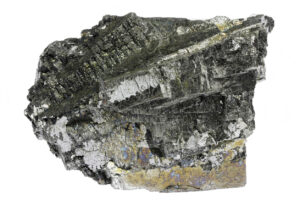
80.95% fine vanadium (ferro vanadium)
Element Name: Vanadium
Atomic Number: 23
Atomic Mass: 50.9415 g/mol
Atomic Symbol: V
Melting Point: 1910° C
Boiling Point: 3407° C
Basics:
In 1831, Vanadium was officially rediscovered by Nils Sefstrom, a Swedish scientist. It is a grey/steel-blue, malleable, and non-brittle transition metal. It has 26 known isotopes, Vanadium-50 and Vanadium-51 being naturally occurring ones. Vanadium’s common oxidation states are +2, +3, +4, and +5.
Interesting Stuff:
Vanadium was discovered twice! It was originally discovered in 1801 in Mexico City by Andrés Manuel del Rio while he was working on the mineral vanadinite, known as “brown lead.” Del Rio sent a letter along with samples of his work to the Institut de France. Sadly, the ship carrying his letter sank and his samples arrived alone. Due to the absence of explanations, it was concluded that the salt was impure Chromium. Vanadium was named after the Swedish Goddess of Beauty and Fertility, Vanadis, due to the brilliant colors of the compounds in which it was first found which include deep yellows, brilliant blues and striking purples. The transition metal has been used over two millennials as it was used for Wootz production in the third century BC. In the 1900’s Henry Ford utilized Vanadium to strengthen the Model-T while making it lighter. It was also used during WWI to make body armor and artillery pieces.
Sources:
Vanadium is not found free in nature but rather in over 60 different minerals. Vanadium is mainly found in South Africa, north-western China, and eastern Russia. Vanadium is obtained from multiple types of mineral deposits and fossil fuels. Such deposits include titanomagnetite ores, primarily used in the production of iron but that also produces Vanadium as a co-product. It can also be extracted as a secondary product from waste like alumina slag, petroleum residues, or even fly ash.
Industrial Uses:
Vanadium is used in steel alloys to increase strength, durability, and corrosion resistance of tubes, pipes, constructions, and rebars. It is also used as a supplement to improve athletic performances and infection recovery. Vanadium Oxide batteries amongst others are used in pacemakers and thus are of high importance in the medical field. It is also commonly used in dyes (Aniline Black), UV and infrared absorbing glass, and ceramic glazes (Vanadium Yellow).
Works Cited
Vanadium Element Facts. (n.d.). https://www.chemicool.com/elements/vanadium.html
Pedersen, T. (2017, August 1). Facts about Vanadium. Live Science. https://www.livescience.com/29155-vanadium.html
VanadiumCorp Resource Inc. – Vanadium and its Uses. (2023). In Vanadiumcorp.com. https://vanadiumcorp.com/our-portfolio/critical-metals-and-vept/vanadium/default.aspx
Alloys, E. (2022, August 28). Cool facts about Vanadium. Eagle Alloys Corporation. https://www.eaglealloys.com/cool-facts-about-vanadium/
Vanadium. (n.d.). USGS. https://www.usgs.gov/publications/vanadium
Vanadium: Overview, uses, side effects, precautions, interactions, dosing and reviews. (n.d.). https://www.webmd.com/vitamins/ai/ingredientmono-749/vanadium#precautions
Hansen, T. (n.d.). V2O5 (Vanadium pentoxide). https://digitalfire.com/oxide/v2o5
Grvghai. (2025, November 10). Applications of vanadium pentoxide in ceramic and glass manufacturing. DS Alloyd. https://www.dsalloyd.com/applications-of-vanadium-pentoxide-in-ceramic-and-glass-manufacturing/
Wikipedia contributors. (2025, May 30). Hardnesses of the elements (data page). Wikipedia. https://en.wikipedia.org/wiki/Hardnesses_of_the_elements_(data_page)