

Calcium
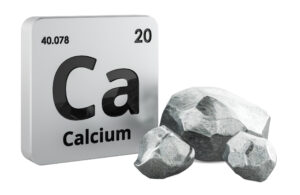
Element Name: Calcium
Atomic Number: 20
Atomic Mass: 40.078 g/mol
Atomic Symbol: Ca
Melting Point: 842° C
Boiling Point: 1484° C
Basics:
In 1789, lime was first classified as “earth” by Antoine Lavoisier as he was unable to further reduce it. In 1808, Calcium was isolated for the first time by Sir Humphry Davy in London, showing that lime was Calcium Oxide. Calcium is a shiny metal that looks similar to Aluminum. Calcium has six naturally occurring isotopes.
Interesting Stuff:
The name Calcium comes from the Latin word “calx,” meaning lime. The reason why Calcium is not commonly found in its metallic form is because it readily reacts with air to form Calcium Hydroxide and Calcium Carbonate. Calcium is the most abundant mineral in our body and is really important as it aids in muscle movement and development, blood circulation, and cell signaling as well as strong and healthy bones. However, we are unable to produce Calcium naturally and thus need to ingest it through our diet. Dairy products, white beans, and sardines contain a large amount of Calcium and can provide us with the necessary Calcium our body needs. For the human body to properly absorb Calcium, it needs vitamin D. Thus, to benefit from a Calcium-rich diet, both vitamin D and Calcium are needed. Calcium also plays an important role in cell signaling.
Sources:
Calcium is commonly found in minerals like limestone, dolostone, and calcareous materials. It is commonly encountered in the form of Calcium Carbonate, and Calcium Sulfate. Lime or Calcium Oxide is typically obtained by heating limestone and has many practical uses in agriculture as well as various industrial uses like water treatment, steel production and pollution control. The three main producers of Calcium include China, the US, and India.
Industrial Uses:
Calcium is a very important element as it is used in a wide variety of areas. For instance, when extracting metals, Calcium can be utilized as a reducing agent. Calcium Carbonate, a Calcium salt is utilized in several processes from the production of cement and mortar to toothpaste. Another salt, Calcium Carbide is utilized to produce acetylene gas and polymers. In addition to being utilized in pyrotechnics and flares, Calcium Phosphide may be employed as a rodenticide and Calcium Arsenate as an insecticide. Fertilizers and animal feed both include Calcium Phosphate. Both blackboard chalk and hemihydrate plaster of Paris are made from Calcium Hydroxide solution. One food additive is Calcium Gluconate.
Works Cited
Gray, T. (2009). The Elements: A Visual Exploration of Every Known Atom in the Universe. Black Dog & Leventhal Publishers.
Calcium – Element information, properties and uses | Periodic Table. (n.d.). https://periodic-table.rsc.org/element/20/calcium
8 Fast Facts about Calcium. (2018, August 14). Healthline. https://healthline.com/health/8-facts-about-calcium#vitamin-d
Calcium compounds | Chemistry | Research Starters | EBSCO Research. (n.d.). EBSCO. https://www.ebsco.com/research-starters/chemistry/calcium-compounds
Calcium | Encyclopedia.com. (n.d.). https://www.encyclopedia.com/science-and-technology/chemistry/compounds-and-elements/calcium