

Thermal Analysis of Inorganic Materials with TA Instruments
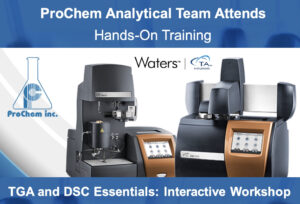 Last week, three members of ProChem Inc.’s team – Dr. Leonel Griego, PhD. (Director of R&D), Dr. Stephanie Gnewuch, PhD (R&D Scientist), and Shannon Brandt (Analytical Chemist) – participated in the TGA and DSC Essentials: Interactive Workshop hosted by TA Instruments in Wood Dale, IL.
This hands-on training focused on Thermogravimetric Analysis (TGA) and Differential Scanning Calorimetry (DSC), two powerful techniques that have become integral to ProChem’s analytical capabilities since the acquisition of the DSC 250 and TGA 550 instruments in May 2024.
The workshop provided in-depth instruction on:
- Instrument calibration and best practices for accurate data collection
- Advanced data interpretation using TA’s TRIOS software
- Programming efficiencies, including template-based automation for routine analyses
“The instructor shared some useful tips about using templates to program the software to automatically perform analyses. It will be a big time-saver for us moving forward,” said Dr. Stephanie Gnewuch, PhD.
These instruments play a critical role in process development and product quality assurance, especially in the characterization of inorganic and metal-organic materials. By investing in continued education and technical mastery, our team ensures that ProChem Inc. remains at the forefront of precision and reliability in high-purity compound analysis.
Applications in Metal-Organic and Inorganic Materials
At ProChem Inc., we purchased our TGA and DSC to aid in the expansion of our β-Diketonate product portfolio, allowing us to evaluate their thermal behavior for process optimization and ensure customer specifications are met. They are also routinely used to evaluate materials such as lanthanide oxides, transition metal salts, and high-purity precursors. TGA helps us determine moisture content, decomposition temperatures, and residual mass – essential for verifying purity and optimizing synthesis conditions. DSC allows us to study phase transitions, melting points, and heat capacity, which are critical for understanding material stability and performance in downstream applications. These insights directly support our customers in industries ranging from electronics and catalysis to advanced ceramics and energy storage.
If you’re interested in learning how TGA and DSC can enhance the performance and consistency of your synthetic materials, we invite you to contact us to explore collaborative solutions.