

Dysprosium (III) Fluoride
Properties
- We can offer items in bulk or custom. For other quantities or purities, please request a quotation.
- All prices are subject to change.
Related Products
Information about Dysprosium (III) Fluoride / CAS 13569-80-7
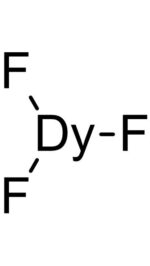
Dysprosium (III) Fluoride (DyF3) is insoluble in water, and has a high melting point of 1,360 degrees Celsius. It is used as the Dysprosium precursor to prepare high-purity Dysprosium metal. It is also used as a reagent for creating lasers, phosphors, and specialty glasses.
For example, a group of researchers from Kyoto University in Japan prepared a number of Dysprosium-doped glass materials to study their fluorescence and luminescence properties. Such materials are used as optical amplifiers in telecommunications applications. With Dysprosium (III) Fluoride they prepared two different Fluoride glasses. One used a mixture of Zirconium (IV) Fluoride, Barium (II) Fluoride, Lanthanum (III) Fluoride, and Dysprosium trifluoride. The other used Indium (III) Fluoride, Zinc (II) Fluoride, Strontium (II) Fluoride, Barium Fluoride, and Dysprosium Fluoride. To prepare the glasses, a small amount of Ammonium Fluoride was added to the mixtures and they were melted at high temperature under a nitrogen atmosphere in a platinum crucible. The emission properties of the glasses were largely impacted by the crystal structure and composition.
In the preparation of Dysprosium metal, a mixture of Dysprosium (III) Fluoride, Lithium Fluoride, and Calcium Fluoride is used to create a molten salt. Researchers from The University of Guelma in Algeria and from the Universite of Toulouse in France performed a series of electrochemical experiments, studying behavior of this molten salt to optimize the production of Dysprosium metal. In their work, the molten salt is contained within a specialized electrolytic cell made of materials resistant to corrosion. They concluded that the electrodeposition of Dysprosium is most efficient with careful choice of a reactive cathode such as Nickel or Copper.
References
Saïla, A., Gibilaro, M., Massot, L., Chamelot, P., Taxil, P., & Affoune, A. M. (2010). Electrochemical behaviour of dysprosium(III) in LiF–CaF2 on Mo, Ni and Cu electrodes. Journal of Electroanalytical Chemistry, 642(2), 150–156. https://doi.org/10.1016/J.JELECHEM.2010.03.002
Tanabe, S., Hanada, T., Watanabe, M., Hayashi, T., & Soga, N. (1995). Optical Properties of Dysprosium-Doped Low-Phonon-Energy Glasses for a Potential 1.3 μm Optical Amplifier. Journal of the American Ceramic Society, 78(11), 2917–2922. https://doi.org/10.1111/J.1151-2916.1995.TB09064.X
Safety

- H315Causes skin irritation.
- H319Causes serious eye irritation.
- H335May cause respiratory irritation.
- P261Avoid breathing dust/fume/gas/mist/vapours/spray.
- P271Use only outdoors or in a well-ventilated area.
- P280Wear protective gloves/protective clothing/eye protection/face protection.
- P302+P252Unknown hazard statement
- P304+P340IF INHALED: Remove victim to fresh air and Keep at rest in a position comfortable for breathing.
- P305+P351+P338IF IN EYES: Rinse cautiously with water for several minutes. Remove contact lenses, if present and easy to do. Continue rinsing.
- P362Take off contaminated clothing and wash before reuse.
- P403+P233Store in a well-ventilated place. Keep container tightly closed.
Learn about this element
