

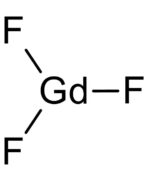
Gadolinium (III) Fluoride, anhydrous
Properties
- We can offer items in bulk or custom. For other quantities or purities, please request a quotation.
- All prices are subject to change.
Related Products
Information about Gadolinium (III) Fluoride, anhydrous / CAS 13765-26-9
Anhydrous Gadolinium (III) Fluoride is insoluble in water, and has a high melting point of 1231 degrees Celsius. It is used as the Gadolinium source to prepare high purity Gadolinium metal from Fluoride salt flux. It is also used as a reagent for preparing Fluoride glasses and ceramics.
For example, a group of researchers from University College Dublin in Ireland were studying Gadolinium Fluoride for use as a scintillator for gamma-ray spectroscopy. They incorporated the Gadolinium trifluoride into a glass-ceramic composed of Silica, Alumina, and Sodium Fluoride by melt-quenching. The glass stabilized the Gadolinium Fluoride in its high-temperature structural form so that it could be studied at room temperature. They were then able to perform detailed crystallographic studies on this high-temperature structure, since the glass was amorphous.
The preparation of Gadolinium metal from molten Fluoride is an electrodeposition process. Researchers from the University of Toulouse in France have performed similar work on several rare earth fluorides. The Gadolinium trifluoride is melted in a Lithium Fluoride–Calcium Fluoride flux contained within a specialized electrochemical cell. They found that using reactive cathodes made of Nickel or Copper, they were able to efficiently extract the Dysprosium metal at high purity.
References
de Faoite, D., Tobin, I., Ulyanov, A., Roberts, O. J., Shortt, B., Hanlon, L., McBreen, S., & Stanton, K. T. (2018). Growth of trigonal gadolinium fluoride in a glass-ceramic for scintillation and optical applications. Journal of the European Ceramic Society, 38(14), 4739–4748. https://doi.org/10.1016/J.JEURCERAMSOC.2018.05.037
Nourry, C., Massot, L., Chamelot, P., & Taxil, P. (2009). Neodymium and gadolinium extraction from molten fluorides by reduction on a reactive electrode. Journal of Applied Electrochemistry 2009 39:12, 39(12), 2359–2367. https://doi.org/10.1007/S10800-009-9922-2
Safety

- H315Causes skin irritation.
- H319Causes serious eye irritation.
- H335May cause respiratory irritation.
- P261Avoid breathing dust/fume/gas/mist/vapours/spray.
- P280Wear protective gloves/protective clothing/eye protection/face protection.
- P302+P352IF ON SKIN: wash with plenty of soap and water.
- P304+P340IF INHALED: Remove victim to fresh air and Keep at rest in a position comfortable for breathing.
- P305+P351+P338IF IN EYES: Rinse cautiously with water for several minutes. Remove contact lenses, if present and easy to do. Continue rinsing.
- P362Take off contaminated clothing and wash before reuse.
Learn about this element
