

Niobium n-Butoxide
Properties
- We can offer items in bulk or custom. For other quantities or purities, please request a quotation.
- All prices are subject to change.
Related Products
Information about Niobium n-Butoxide / CAS 51030-47-8
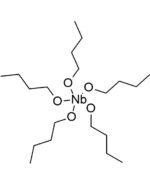
Niobium n-Butoxide (Nb(OC4H9)5), is a colorless or pale-yellow alkoxide. It is primarily used as a Niobium precursor in sol-gel, solvothermal, and atomic layer deposition processes to produce Niobium-containing films. Like all water-sensitive alkoxides, Niobium n-Butoxide readily hydrolyzes, and upon heating forms Niobium pentoxide (Nb2O5). It is also incorporated into synthetic processes with other metal precursors to form niobates such as Lithium Niobate (LiNbO3). Lithium Niobate has numerous optical and opto-electronic applications, including non-volatile holographic storage, ultrafast laser writing, electro-optical resonators, and surface acoustic wave devices.
As an example, researchers from Kyoto University in Japan used Niobium n-Butoxide and Niobium Ethoxide as precursors in a glycothermal method to produce numerous different Niobium double oxides. They included LiNbO3, Zr6Nb2O17, CaNb2O6, CrNbO4, FeNbO4, and ZnNb2O6. There were several other compositions which gave amorphous products from the glycothermal treatment but gave crystalline products upon calcination. For example, strontium and Barium Acetate precursors both gave amorphous materials, but upon calcination at 700 and 750 degrees Celsius respectively, Strontium Niobate (SrNb2O6) and Barium Niobate (BaNb2O6 ) formed. In another example, researchers from Simon Fraser University in Canada leveraged the water sensitivity of Niobium n-Butoxide to prepare Lithium Niobate (LiNbO3) particles with a hydrothermal method. After preparation and calcination at 600 degrees Celsius resulted in a crystalline, porous material suitable for use in optical imaging probes, photocatalysts, or drug delivery carriers.
Niobium n-Butoxide can also be used to create thin films. Researchers from the Science University of Tokyo used Niobium n-Butoxide in a sol-gel process to prepare Barium Sodium Niobate (Ba2NaNb5O15). Barium Sodium Niobate is a ferroelectric material, which can be used in nonvolatile memory devices. They used Barium Acetate, Sodium Nitrate, and Niobium n-Butoxide as the metal precursors, and prepared solutions with acetic acid and methyl carbitol. The resultant gel which was coated on a quartz plate. After calcination and heat treatment from 600 to 800 degrees Celsius in an oxygen atmosphere, they obtained a thin film of Ba2NaNb5O15. The material superior ferroelectric behavior to a previously reported method of preparing a thin film of this material.
- Kominami, H., Inoue, M., & Inui, T. (1993). Formation of niobium double oxides by the glycothermal method. Catalysis Today, 16(3–4), 309–317. https://doi.org/10.1016/0920-5861(93)80070-H
- Fujihashi, G., Kakimi, A., Ando, S., Okamura, S., Tsuchiya, T., & Tsukamoto, T. (1997). Preparation of Ba2NaNb5O15 Thin Films by the Sol-Gel Method. Journal of the Ceramic Society of Japan, 105(1221), 449–451. https://doi.org/10.2109/jcersj.105.449
- Faryad Ali, R., & Gates, B. D. (2022). Lithium niobate particles with a tunable diameter and porosity for optical second harmonic generation. RSC Advances, 12(2), 822–833. https://doi.org/10.1039/d1ra07216a
Safety

- H227Combustible liquid.
- H315Causes skin irritation.
- H319Causes serious eye irritation.
- P280Wear protective gloves/protective clothing/eye protection/face protection.
- P305+P351+P338IF IN EYES: Rinse cautiously with water for several minutes. Remove contact lenses, if present and easy to do. Continue rinsing.