Scandium (III) Acetate Hydrate
Properties
- We can offer items in bulk or custom. For other quantities or purities, please request a quotation.
- All prices are subject to change.
Related Products
Information about Scandium (III) Acetate Hydrate / CAS 304675-64-7
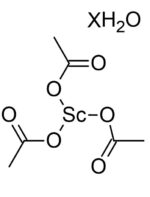
Scandium Acetate hydrate is a white, water-soluble salt. It is a versatile precursor for preparing Scandium-containing materials. Since it is water-soluble, it can be incorporated into aqueous synthetic processes. Alternatively, it can be heated to decompose the acetate and prepare scandium oxide.
Recently, Scandium Acetate was found to be an excellent electrolyte additive for Zinc Sulfate solution in Zinc metal anode batteries. Researchers from the Chinese Academy of Sciences in Jiangxi found the Scandium and Acetate ions facilitate the dissolution of Zinc ions, lowering the energy needed for Zinc electroplating to occur. The Scandium Acetate additive also increases the lifespan of the electrolytic cell.
Scandium Acetate is also a suitable precursor for aqueous-based syntheses. Materials chemists from the Madrid Institute of Materials Science in Spain used Scandium Acetate and their Scandium precursor in the synthesis of a Scandium terephthalate metal organic framework (MOF). An aqueous solution of Scandium Acetate, terephthalic acid, sodium terephthalate and o-phenanthroline, were combined and heated in a teflon-lined autoclave at 180 degrees Celsius for four days. The transparent crystals were obtained in high yield. The material was tested for catalytic activity and found to convert thiethers to sulfoxides and sulfones in the presence of hydrogen peroxide with gentle heating at 50 degrees Celsius in acetonitrile.
Researchers at the Swiss Federal Institute of Technology in Lausanne used Scandium Acetate to produce thin films of Lead Scandium Tantalate (Pb(Sc₀.₅Ta₀.₅)O₃), a relaxor ferroelectric material used in high-efficiency energy storage, electrocaloric cooling, and precision motion control. Using a sol-gel method under an inert argon atmosphere, scandium acetate was dehydrated, dissolved in 2-methoxyethanol, and combined with Tantalum Ethoxide, then refluxed. Lead Acetate was separately dehydrated and dissolved before being added to the mixture. After further reaction and concentration, thin films were formed by spin-coating and pyrolysis. Multiple layers were applied, and the final film was annealed in oxygen at high temperature to achieve the desired material properties.
- Perles, J., Iglesias, M., Martín-Luengo, M. Á., Monge, M. A., Ruiz-Valero, C., & Snejko, N. (2005). Metal-organic scandium framework: Useful material for hydrogen storage and catalysis. Chemistry of Materials, 17(23), 5837–5842. https://doi.org/10.1021/cm051362e
- Brinkman, K., Wang, Y., Cantoni, M., Su, D., Setter, N., & Petrov, P. K. (2011). Processing and properties of ferroelectric relaxor lead scandium tantalate Pb(Sc1/2Ta1/2)O3 thin films. Journal of Materials Research 2007 22:1, 22(1), 217–232. https://doi.org/10.1557/jmr.2007.0023
- Chen, C., Li, L., Long, Z., Ang, E. H., & Liang, Q. (2024). Enabling stable aqueous Zn metal anodes using scandium acetate electrolyte additives. Journal of Materials Chemistry A, 12(30), 18968–18976. https://doi.org/10.1039/D4TA02133A
Safety
Learn about this element