

Ytterbium (III) Acetate Tetrahydrate
Properties
- We can offer items in bulk or custom. For other quantities or purities, please request a quotation.
- All prices are subject to change.
Related Products
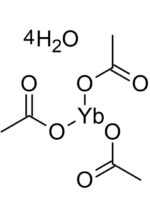
Information about Ytterbium (III) Acetate Tetrahydrate / CAS 15280-58-7
Ytterbium Acetate tetrahydrate, is a white, crystalline precursor and dopant for materials science and nanotechnology. Like other rare earth ions, trivalent Ytterbium is fluorescent and is used in lasers as well as materials for lighting and biomedical imaging.
Ytterbium Acetate is soluble in water and polar organic solvents like ethylene glycol or 1,4-butanediol, making it suitable for solution-based processing. It decomposes to Ytterbium Oxide above 600° C, and can be used as a dopant for ceramic-oxides. For example, researchers from the Massachusetts Institute of Technology and Ames Laboratory were able to prepare Ytterbium (III) Fluoride nanoparticles using Ytterbium (III) Acetate tetrahydrate as the precursor. The Acetate salt was dissolved in ethylene glycol and then combined with a suitable ionic liquid. The reaction mixture was heated in either an autoclave or microwave reactor to obtain highly crystalline nanoparticles. Such nanoparticles can be used in lighting and bioimaging technologies.
In another example, researchers from Keio University and Shiga University of Medical Science in Japan used Ytterbium Acetate tetrahydrate as a dopant in the preparation of nanocrystalline Yttrium Aluminum Garnet (YAG). They utilized a glycothermal method using the reagents Yttrium Acetate tetrahydrate, Ytterbium Acetate tetrahydrate, and Aluminum Isopropoxide. After reaction in an autoclave, the materials were calcined to remove any organic species which could inhibit the material’s fluorescence. The final materials had a suitable crystallinity for use in near infrared fluorescent experiments in biomedical research.
References
- Karraker, D. G. Coordination of Lanthanide Acetates. J. Inorg. Nucl. Chem. 1969, 31 (9), 2815–2832.
- Lorbeer, C.; Mudring, A.-V. The Synthesis of Highly Crystalline Ytterbium(III) Fluoride Nanoparticles from Ionic Liquids. In Ceramic Materials for Energy Applications V: A Collection of Papers Presented at the 39th International Conference on Advanced Ceramics and Composites; Matyáš, J., Katoh, Y., Lin, H.-T., Vomiero, A., Eds.; John Wiley & Sons, Inc., 2016; pp 137–148.
- Asakura, R.; Sakane, H.; Noda, K.; Isobe, T.; Morita, M.; Inubushi, T. Fluorescent and Magnetic Resonance Imaging by Rare Earth Doped Nanoparticles with Garnet Structure. Mater. Res. Soc. Symp. Proc. 2008, 1064, 1064-PP03-06.
- Ribot, F.; Toledano, P.; Sanchez, C. X-ray and spectroscopic investigations of the structure of yttrium acetate tetrahydrate. Inorg. Chim. Acta 1991, 185 (2), 239–245.
- Hussein, G. A. M.; Balboul, B. A. A. Ytterbium Oxide from Different Precursors: Formation and Characterization: Thermoanalytical Studies. Powder Technol. 1999, 103 (2), 156–164.
Safety
Learn about this element
