

Yttrium (III) Nitrate Tetrahydrate
Properties
- We can offer items in bulk or custom. For other quantities or purities, please request a quotation.
- All prices are subject to change.
Information about Yttrium (III) Nitrate Tetrahydrate / CAS 13773-69-8
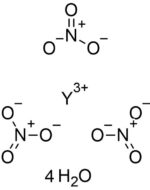
Yttrium (III) Nitrate tetrahydrate (Y(NO₃)₃·4H₂O) is a water-soluble rare-earth compound with multiple applications in advanced material synthesis, as well as specialty applications in electronics and biomedical research. Its high solubility and reactivity make it an essential precursor for producing high-purity Yttrium Oxide (Y₂O₃), which is integral to many industrial and scientific applications. The controlled thermal decomposition of Yttrium Nitrate allows for precise Y₂O₃ formation, ensuring superior performance in various fields.
In materials science, Yttrium Oxide nanoparticles synthesized from Yttrium Nitrate exhibit exceptional thermal stability, optical transparency, and electrical insulation properties. These characteristics make them suitable for high-performance ceramics, optoelectronics, and laser applications. Y₂O₃-based materials are widely used in the development of luminescent phosphors for LEDs, enhancing energy-efficient lighting technologies. The compound’s unique ability to produce defect-free thin films further strengthens its role in microelectronics and photonics.
Yttrium (III) Nitrate tetrahydrate is also a crucial precursor in sol–gel synthesis, facilitating the deposition of Y₂O₃ thin films. These films serve as high-quality dielectric layers in semiconductor devices, particularly in gate dielectrics for field-effect transistors (FETs). When subjected to ultraviolet (UV)/ozone treatment, these films achieve uniform, defect-free morphologies, improving their dielectric properties—essential for next-generation flexible electronics and display technologies.
The aerospace and energy industries benefit significantly from yttrium-stabilized materials. Y₂O₃, produced from Yttrium Nitrate, is incorporated into thermal barrier coatings and structural ceramics, enhancing the high-temperature resistance of aerospace components and turbine blades. These coatings protect against oxidation, thermal shock, and wear, prolonging the operational lifespan of jet engines and industrial gas turbines. Furthermore, yttria-stabilized zirconia (YSZ), derived from Yttrium precursors, is widely utilized in solid oxide fuel cells (SOFCs) due to its superior ionic conductivity and stability under extreme conditions, making it a key material for sustainable energy solutions.
Safety

- H272May intensify fire; oxidizer.
- H315Causes skin irritation.
- H319Causes serious eye irritation.
- H335May cause respiratory irritation.
- P210Keep away from heat/sparks/open flames/hot surfaces. — No smoking.
- P220Keep/Store away from clothing/.../combustible materials.
- P221Take any precaution to avoid mixing with combustibles/...
- P261Avoid breathing dust/fume/gas/mist/vapours/spray.
- P264Wash skin thoroughly after handling.
- P271Use only outdoors or in a well-ventilated area.
- P280Wear protective gloves/protective clothing/eye protection/face protection.
- P302+352Unknown hazard statement
- P304+P340IF INHALED: Remove victim to fresh air and Keep at rest in a position comfortable for breathing.
- P305+P351+P338IF IN EYES: Rinse cautiously with water for several minutes. Remove contact lenses, if present and easy to do. Continue rinsing.
- P362Take off contaminated clothing and wash before reuse.
- P370+P378In case of fire: Use ... for extinction.
- P403+P233Store in a well-ventilated place. Keep container tightly closed.
Learn about this element
