Terbium (III) Sulfate Octahydrate
Properties
- We can offer items in bulk or custom. For other quantities or purities, please request a quotation.
- All prices are subject to change.
Related Products
Information about Terbium (III) Sulfate Octahydrate / CAS 13842-67-6
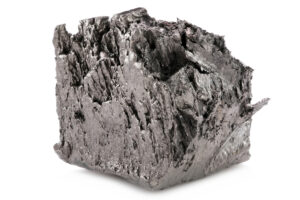
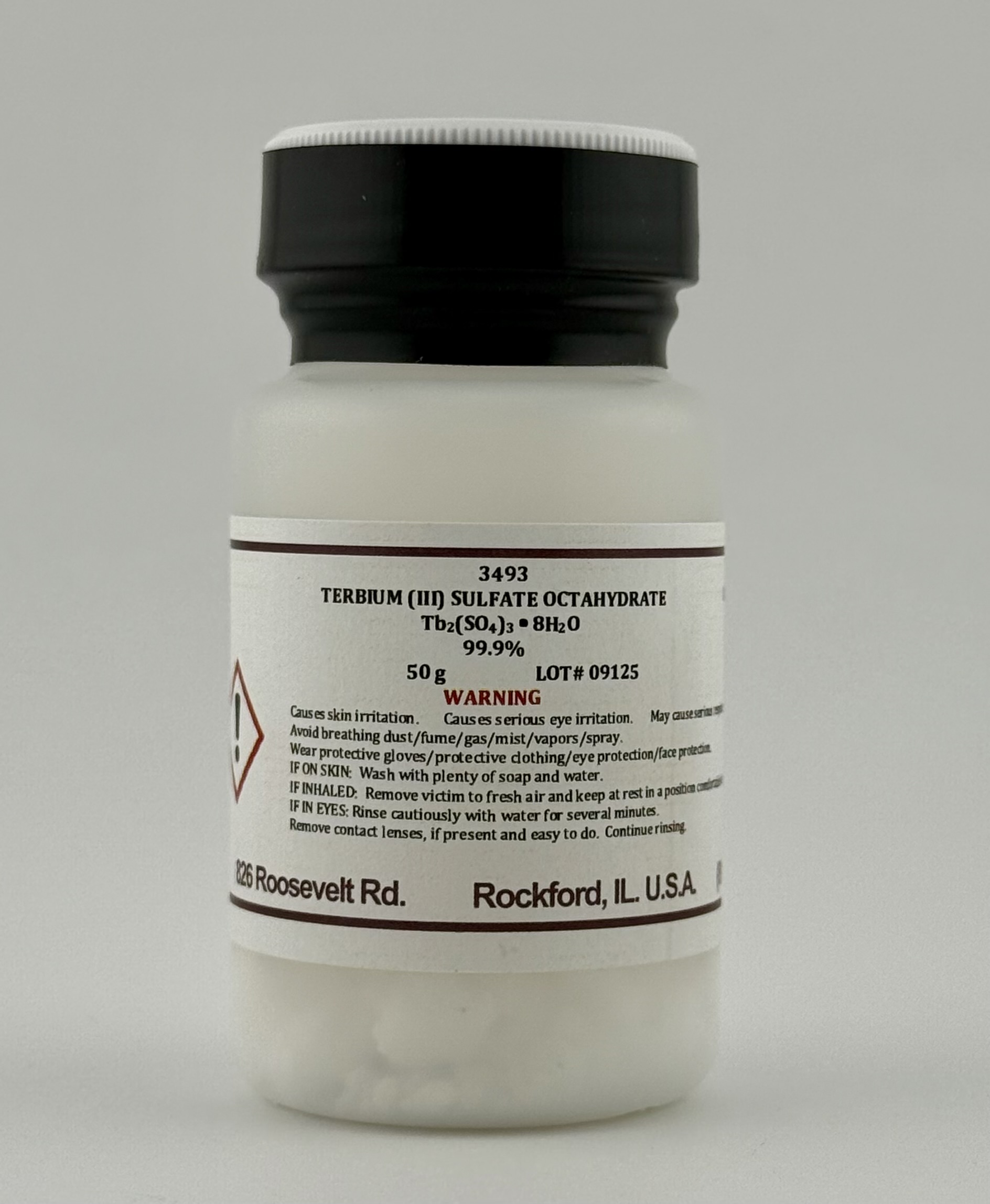
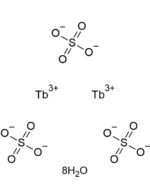
Terbium Sulfate Octahydrate is a water-soluble terbium salt. Like Terbium Acetate, the solubility of Terbium Sulfate makes it a suitable precursor for precipitation-based or sol-gel synthetic methods. When excited, terbium ions emit bright green light. Terbium ions retain their luminescent properties when doped in in ceramic materials, making it suitable as a phosphor for field emission displays (FEDs) or light-emitting diodes (LEDs).
Researchers from the National Autonomous University of Mexico have published several papers on terbium-doped phosphor materials. In one paper they prepared beta-Calcium pyrophosphate materials, with 1% of the Calcium atom sites doped with terbium. They prepared ethanolic solutions of Calcium Acetate, Terbium Sulfate, and Phosphoric acid. When combined, a powder precipitated from solution, which was briefly dried at 100 degrees Celsius and then annealed at 900 degrees Celsius. The precipitated material was structurally related to brushite [Ca(HPO4)•2H2O]. The structure of the annealed material corresponded to beta-Calcium pyrophosphate [Ca2P2O7]. In another paper, they prepared both Terbium-doped and Cerium-doped alpha-Strontium pyrophosphate materials. For their synthetic process, they used aqueous solutions of Strontium Chloride and Ammonium Phosphate Dibasic. Aqueous solutions of either Cerium Sulfate or Terbium Sulfate were used as dopants, on a 1% molar basis. The aqueous solutions were vigorously heated at 250 degrees Celsius, until the water evaporated. The amorphous residues were annealed at 900 degrees Celsius for 18 hours to obtain the final materials. The Cerium-doped and Terbium-doped materials were structurally analogous. Both studies indicated the prepared materials exhibited good luminescent properties.
Another research group from São Paulo, Brazil used Terbium Sulfate to prepare Terbium-doped Gadolinium oxysulfate. Gadolinium Sulfate, Terbium Sulfate, and samples of Gadolinium Sulfate doped with Terbium Sulfate were calcined in air up to 1400 degrees Kelvin (1127 degrees Celsius). The calcination process was studied by thermo-gravimetric analysis and the doped material was found to form between 1290-1320 degrees Kelvin (1017-1047 degrees Celsius). Three doped materials were studied, at Terbium concentrations of 0.1, 1.0, and 10.0 mol percent. The materials with higher Terbium content exhibited superior optical properties. All doped samples emitted green light and are suitable for field emission display devices (FEDs) and light-emitting diodes (LEDs).
- Roman-Lopez, J., Lozano, I. B., Cruz-Zaragoza, E., Castañeda, J. I. G., & Díaz-Góngora, J. A. I. (2017). Synthesis of β-Ca2P2O7:Tb3+ to gamma radiation detection by thermoluminescence. Applied Radiation and Isotopes, 124, 44–48. https://doi.org/10.1016/J.APRADISO.2017.03.004
- Lozano, I. B., Roman-Lopez, J., Valverde, M., Garcia-Hipolito, M., Díaz-Góngora, J. A. I., Castañeda, J. I. G., & Alarcon-Flores, G. (2019). Thermoluminescence properties of cerium and terbium doped alpha-strontium pyrophosphate. Radiation Measurements, 129, 106192. https://doi.org/10.1016/J.RADMEAS.2019.106192
- 3. Rodrigues, R. v., Marciniak, Khan, L. U., Muri, E. J. B., Cruz, P. C. M., Matos, J. R., Strȩk, W., & Marins, A. A. L. (2020). Impact of Tb3+ ion concentration on the morphology, structure and photoluminescence of Gd2O2SO4:Tb3+ phosphor obtained using thermal decomposition of sulfate hydrate. Luminescence, 35(8), 1254–1263. https://doi.org/10.1002/BIO.3886
Safety

- H315Causes skin irritation.
- H319Causes serious eye irritation.
- H335May cause respiratory irritation.
- P261Avoid breathing dust/fume/gas/mist/vapours/spray.
- P280Wear protective gloves/protective clothing/eye protection/face protection.
- P302+P352IF ON SKIN: wash with plenty of soap and water.
- P304+P340IF INHALED: Remove victim to fresh air and Keep at rest in a position comfortable for breathing.
- P305+P351+P338IF IN EYES: Rinse cautiously with water for several minutes. Remove contact lenses, if present and easy to do. Continue rinsing.
Learn about this element