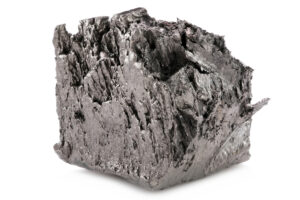

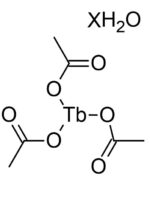
Terbium (III) Acetate Hydrate
Properties
- We can offer items in bulk or custom. For other quantities or purities, please request a quotation.
- All prices are subject to change.
Related Products
Information about Terbium (III) Acetate Hydrate / CAS 100587-92-6
Terbium Acetate hydrate is a colorless, water-soluble crystalline material. Like Terbium Sulfate, the solubility of Terbium Acetate makes it a suitable precursor for precipitation-based or sol-gel synthetic methods. Terbium ions emit green light, making them suitable as phosphors for LEDs. Terbium’s emission spectrum is due to the electronic transitions allowed by electrons in the f-orbitals of the ions.
Researchers at Peking University prepared luminescent, terbium-doped Zinc Oxide nanocrystals using Terbium Acetate for optoelectronic applications. Zinc Acetate and Terbium Acetate were refluxed in ethanol, followed by Lithium Hydroxide addition and sonication to form a colloidal suspension. Nanoparticles were then precipitated with hexane, purified through repeated redispersion, and isolated. Residual acetate on the surface helped limit crystal growth, maintaining nanocrystalline size. After drying, the material showed characteristic photoluminescence from Tb³⁺ ions.
Terbium Acetate has been used to synthesize luminescent metal–organic frameworks (LMOFs) for nitrite sensing due to their tunable structures and high surface area. Researchers at National Cheng Kung University prepared a two-dimensional Zirconium-based MOF (Zr-BTB) using 1,3,5-tri(4-carboxylphenyl)benzene linkers, then incorporated Terbium (III) Acetate via post-synthetic modification in dimethylformamide. After washing and solvent removal, the material was tested in water–ethanol dispersions. Nitrite quenched terbium emission in a concentration-dependent manner, while the organic framework enhanced signal sensitivity. The work demonstrated the suitability for the terbium-doped LMOF for nitrite sensing.
- Chen, Y.-L., Shen, C.-H., Huang, C.-W., & Kung, C.-W. (2023). Terbium-modified two-dimensional zirconium-based metal-organic frameworks for photoluminescence detection of nitrite. Mol. Syst. Des. Eng, 8, 330. https://doi.org/10.1039/d2me00214k
- Liu, S. M., Liu, F. Q., Guo, H. Q., Zhang, Z. H., & Wang, Z. G. (2000). Correlated structural and optical investigation of terbium-doped zinc oxide nanocrystals. Physics Letters A, 271(1–2), 128–133. https://doi.org/10.1016/S0375-9601(00)00341-8
Safety
Learn about this element