

Praseodymium (III) Acetate Hydrate
Properties
- We can offer items in bulk or custom. For other quantities or purities, please request a quotation.
- All prices are subject to change.
Related Products
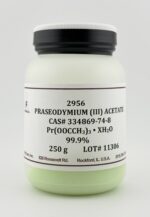
Information about Praseodymium (III) Acetate Hydrate / CAS 334869-74-8
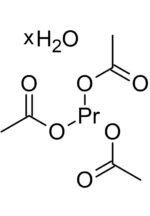
Praseodymium (III) Acetate hydrate (PrOOCCH3)3•xH2O is a water-soluble lime green salt. It is used in ceramic and glass manufacturing to create a rich yellow color. It is also a precursor for Praseodymium-containing materials, including magnetic materials. In addition, it can also be used in protein crystallization. Rare-earth metal salts can be added to protein crystallization solutions. Due to their ion size, the rare-earth ions can bind at protein active sites, such as Neodymium (Nd3+) replacing Ca2+ in trypsinogen. Since rare earth ions are magnetically active and have electronic transitions in the visible spectrum, a variety of analytical techniques can be used to study the protein binding sites.
For example, researchers from the Autonomous University of Madrid and the Complutense University of Madrid, used Praseodymium (III) Acetate in their synthesis of Pr2BaCoO5, Praseodymium Barium Cobalt Oxide. In the synthesis, Barium Carbonate, Cobalt Carbonate, and Praseodymium Acetate were ground in stoichiometric ratio, and fired at 1150 degrees Celsius in Alumina crucibles under an Argon atmosphere. The material was subjected to multiple rounds of heat treatments with intermittent regrinding, for a total firing time of 24 hours. Praseodymium Acetate was chosen due to its decomposition in Argon, which produces a reducing environment via the formation of Carbon Monoxide and prevents the oxidation of the Praseodymium and Cobalt ions.
Indeed, in 2008 Abu-Zied and Soliman from Assiut University in Egypt studied the thermal decomposition of Praseodymium Acetate and observed a complex decomposition process. Praseodymium Oxides exist in compositions from Pr2O3 (which can be thought of as PrO1.5), various non-stoichiometric compositions including PrOx (x = 1.67, 1.714, 1.780, 1.810, and 1.833), and PrO2. It first decomposes to Pr(OH)(CHCOO)2 around 290 degrees Celsius, then to PrO(CH3COO) around 358 degrees Celsius, until it eventually forms Pr2O2(CO3) around 405 degrees Celsius. The final step involves the loss of a mixture of CO and CO2, forming PrO1.833 (which can be thought of as Pr6O11) up to 700 degrees Celsius. The same decomposition results were obtained in both nitrogen and air atmospheres. Any composition of PrOx where 1.5 < x < 2 has a mixture of both Pr3+ and Pr4+. This is likely what was happening in the synthesis of Pr2BaCoO5.
More recently in 2019, Praseodymium Acetate was used to study the crystal structure of a mutated form of MdfA, a multidrug transporter protein. The researchers from Rosalind Franklin University in North Chicago, Illinois incorporated Praseodymium Acetate in a crystallization solution which included 4-morpholineethanesulfonic acid (MES-NaOH), Sodium Chloride, Magnesium Chloride, and polyethylene glycol (PEG400). Since Pr3+ is such a large ion with many electrons in its valence shell, the pronounced scattering of X-rays from the Praseodymium ions in their X-ray diffraction experiments were analyzed to determine the protein crystal structure.
- Hernández-Velasco, J., Sáez-Puche, R., Rodríguez-Carvajal, J., García-Matres, E., & Martínez, J. L. (1994). Magnetic properties of novel R2BaCoO5 oxides (R = Pr, Nd, Ho). Journal of Alloys and Compounds, 207–208(C), 257–262. https://doi.org/10.1016/0925-8388(94)90216-X
- Abu-Zied, B. M., & Soliman, S. A. (2008). Thermal decomposition of praseodymium acetate as a precursor of praseodymium oxide catalyst. Thermochimica Acta, 470(1–2), 91–97. https://doi.org/10.1016/j.tca.2008.02.002
- Wu, H. H., Symersky, J., & Lu, M. (2019). Structure of an engineered multidrug transporter MdfA reveals the molecular basis for substrate recognition. Communications Biology 2019 2:1, 2(1), 210-. https://doi.org/10.1038/s42003-019-0446-y
- Darnall, D. W., & Birnbaum, E. R. (1970). Rare Earth Metal Ions as Probes of Calcium Ion Binding Sites in Proteins. Journal of Biological Chemistry, 245(23), 6484–6486. https://doi.org/10.1016/S0021-9258(18)62634-1
Safety
Learn about this element
