
Rubidium
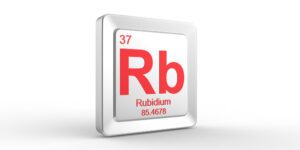
Element Name: Rubidium
Atomic Number: 37
Atomic Mass: 85.4678
Atomic Symbol: Rb
Melting Point: 39.3° C
Boiling Point: 688° C
Basics:
In 1861, Robert Bunsen and Gustav Kirchhoff dissolved the mineral lepidolite in acid and obtained a new alkali metal, Rubidium. It is a very soft silvery-white alkali metal that actively reacts with water, leading to the formation of Rubidium Hydroxide, a corrosive compound, and hydrogen gas. Rubidium has 35 known isotopes, with only two (Rubidium-85 and Rubidium-87) occurring naturally.
Interesting Stuff:
Upon analyzing the atomic spectrum of Rubidium for the first time, two intense ruby red-colored lines showed up. For this reason, the alkali metal was named after the Latin word “rubidus,” meaning “deepest red.” Rubidium is a slightly radioactive alkali metal and has a high vapor pressure. Due to its similarity with Potassium, our body mistakes Rubidium for Potassium and absorbs it. Rubidium is known as an “incompatible element” because as magma cools down to form a rock, Rubidium does not crystallize with the rest of the other elements contained in the magma due to its larger atomic size. This results in a separation between early-forming minerals that contain no to very little Rubidium and late-forming minerals that are packed with Rubidium (Potassium-containing minerals like mica and feldspar).
Sources:
Rubidium is mainly found in minerals like pollucite, carnallite, leucite, and lepidolite (its main ore which contains 1.5% Rubidium). It is obtained as a by-product during Lithium extraction. Potassium minerals and brines appear to be another source of Rubidium.
Industrial Uses:
Rubidium is used as working fluid in vapor turbines and aids as a getter in removing trace gases in photocell vacuum tubes. Rubidium-87 is used in rock dating due to its slight radioactivity. This isotope’s frequency is also used as a way to regulate the quartz oscillator in clocks to maintain the appropriate rhythm. When ignited, Rubidium burns with a reddish-violet color and is thus often used in purple fireworks. It is also an important component of certain kinds of glass as some of its salts are used in fiber optic glass, specialized medical glass, and glass coloration. Rubidium is also used to research Potassium ion channels and cellular behavior due to their similarity and the body wanting to absorb the Rubidium because it thinks it is Potassium. This metal also plays a role in the production of its superoxide for quantum research related to electron states and magnetism.
Works Cited
Chemtalk. (2023, April 4). The radiant element rubidium. ChemTalk. https://chemistrytalk.org/rubidium-element/
Rubidium – New World Encyclopedia. (n.d.). https://www.newworldencyclopedia.org/entry/Rubidium
Rubidium – Element information, properties and uses | Periodic Table. (n.d.). https://periodic-table.rsc.org/element/37/rubidium
Wikipedia contributors. (2026, June 19). Rubidium. Wikipedia. https://en.wikipedia.org/wiki/Rubidium
Rubidium Element Facts. (n.d.). https://www.chemicool.com/elements/rubidium.html