
Lithium
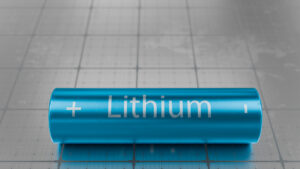
Blue lithium-ion battery with positive and negative contacts
Element Name: Lithium
Atomic Number: 3
Atomic Mass: 6.94 g/mol
Atomic Symbol: Li
Melting Point: 180.50° C
Boiling Point: 1342° C
Basics:
Lithium was discovered by Johan August Arfwedson in 1817 while working on a mineral known as petalite. It is a silvery-looking metal that was found to be the least dense metal on the periodic table. This characteristic allows it to float on water. There are two known stable isotopes of lithium: lithium-6 and lithium-7 (most abundant). Lithium is soft enough to cut with hand shears. Multiple allotropes have been identified at high pressures.
Interesting Stuff:
While other common alkali metals were discovered in plants, Lithium was first discovered in a mineral. This has led to the origin of its name from the Greek word “lithos” meaning “stone.” Lithium was used in the production of high temperature greases for aircraft engines notably during World War II. The soda 7UP was originally advertised as a “Bib-label Lithiated Lemon-Lime Soda” in 1929. 7UP contains the compound Lithium Citrate which is a metal-organic compound derived from Lithium. Lithium has recently been nicknamed “white gold” because of the soaring global demand in the battery industry.
Sources:
Lithium can be found in certain minerals like spodumene, lepidolite, and petalite. It also comes from brine deposits which are found in salt lakes. However, Lithium is not commonly found free in nature because of how reactive it is with air and water, which is why the metal must be purified from the mineral materials. While brine harvesting is a much more common way of extracting Lithium than drilling through rocks, it yields much lower grade Lithium. The largest Lithium deposit in the world is in Bolivia, but much of this deposit is underdeveloped because of lack of infrastructure.
Industrial Uses:
Lithium is primarily used in phone and computer rechargeable batteries because it delivers significantly more energy than other metal-based batteries as well as being ultra-lightweight. However, it also has many other uses, notably heart pacemakers for medicinal purposes, toys, and clocks. Lithium and its related compounds have been used in a wide variety of other areas. For instance, Lithium Oxide is used in glass ceramics and Lithium Hydride is essential to store hydrogen as a fuel. Lithium Carbonate is a key component of medications to treat manic depression and bipolar disorder because it reduces dopamine receptor activity. Finally, Lithium Bromide and Lithium Chloride are also commonly used in air conditioning and drying systems.
Works Cited
Lithium – Element information, properties and uses | Periodic Table. (n.d.). https://periodic-table.rsc.org/element/3/lithium
Lithium Element Facts. (n.d.). https://www.chemicool.com/elements/lithium.html
Wikipedia contributors. (2026, June 8). Lithium. Wikipedia. https://en.wikipedia.org/wiki/Lithiun#
Gray, T. (2009). The Elements: A Visual Exploration of Every Known Atom in the Universe. Black Dog & Leventhal Publishers.
Labelmaster, & Labelmaster. (2018, December 6). 13 things you may not know about lithium, batteries, and lithium batteries. Labelmaster Blog. https://blog.labelmaster.com/13-things-you-may-not-know-about-lithium-batteries-and-lithium-batteries/