
Zirconium
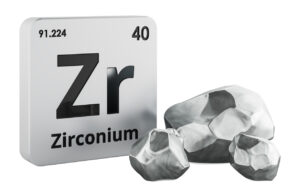
Zirconium Metal
Element Name: Zirconium
Atomic Number: 40
Atomic Mass: 91.224 g/mol
Atomic Symbol: Zr
Melting Point: 1855° C
Boiling Point: 4409° C
Basics:
Zirconium was discovered in a sample of zircon and recognized as an element in 1789 by Martin Heinrich Klaproth. It was not isolated until 1824 after many trials involving various purification methods like electrolysis were performed. Zirconium is a shiny grey-silvery metal that is resistant to corrosion. Zirconium is also highly ductile and malleable while resisting extreme heat. It has five naturally occurring isotopes.
Interesting Stuff:
Zirconium comes from zircon, a mineral dating back more than 4.4 billion years. Its name comes from the Persian word “zargun,” which means gold-like. Zircon can be found in a wide variety of colors ranging from blue to red, and occasionally purple. A star, LS IV-14 116, also known as the “diamond star” shines like a diamond due to the high amounts of zirconium in its atmosphere compared to other stars like our sun. In Ancient Greece and Rome, zircon gemstones were used as jewelry and were referred to as “hyacinth” or “jacinth” after the hyacinth flower petals.
Sources:
Zirconium is found in over 35 different minerals, the major one being zircon which relatively widespread on Earth. Zircon is commonly found in the sand deposits of coastal waters. It is dispersed inside the ground and is not found in “bulk.” Australia, China, Indonesia, South Africa, and Ukraine are the most important sources of Zirconium. Zirconium was also identified to be part of stars’ atmosphere and lunar rocks.
Industrial Uses:
Zirconium is a key player in the production of nuclear energy. For instance, it has shown to be indispensable as a coating for long, cylindrical rods inside nuclear reactors. Due to its high temperature and corrosion resistance, Zirconium is utilized to cover Uranium pellets. In addition, it also absorbs almost none of the neutrons that are expelled during a nuclear fission reaction which aids in energy production. Zirconium is also used in nuclear submarines. While it is mainly used in the nuclear field, Zirconium is also very useful to the chemical industry, notably due to its high resistance to acids and alkalis. In the medical field, Zirconium (IV) Oxide as a material for dental and surgical implants thanks to its longevity and biocompatibility. In addition, Zirconium is utilized in the production of furnace bricks, television glass, lamp filaments, ceramics, and catalytic converters. Finally, Zirconium Dioxide is also used as a replacement for diamonds and is known as “cubic zirconia.”
Works Cited
Gray, T. (2009). The Elements: A Visual Exploration of Every Known Atom in the Universe. Black Dog & Leventhal Publishers.
Pajak-Reynolds, M. (2026, January 1). Michelle Pajak-Reynolds-Artisan Jewelry Blog | Creative Process, Tips & Stories-Zircon Gemstone Meaning, History & Care: An Ancient story told in sparkle and stone. Michelle Pajak-Reynolds. https://michellepajakreynolds.com/journal/gemstone-spotlight-zircon
Zirconium – Element information, properties and uses | Periodic Table. (n.d.). https://periodic-table.rsc.org/element/40/zirconium
Zirconium element facts. (n.d.). https://www.chemicool.com/elements/zirconium.html