Zirconium (IV) Sulfate Tetrahydrate
Properties
- We can offer items in bulk or custom. For other quantities or purities, please request a quotation.
- All prices are subject to change.
Related Products
Information about Zirconium (IV) Sulfate Tetrahydrate / CAS 7446-31-3
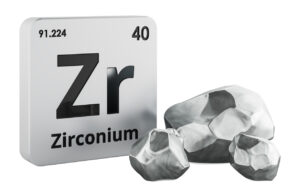
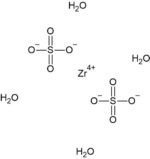
Zirconium (IV) Sulfate tetrahydrate—Zr(SO4)2•4 H2O—is a colorless and highly water-soluble Zirconium salt. While most transition metal sulfates and chlorides exhibit similar chemistry in aqueous solutions, Zirconium Sulfate behaves very differently from Zirconium Chloride. For example, when alkali is added to aqueous Zirconium Chloride solution, hydrous Zirconia particles precipitate, which are composed of Zirconium Oxide (ZrO2) with water molecules and hydroxyl ions on the surface. Whereas, when alkali is added to aqueous Zirconium Sulfate solution, it forms basic Zirconium Sulfate—or Zirconyl Sulfate solution ZrO(SO4)2.
It has long been known that Zirconium Sulfate tetrahydrate will decompose at temperatures above 600° C to form Zirconium Oxide. However, more recently it has been found that the residual sulfate ions result in a robust “sulfated Zirconia” material with catalytic properties. Sulfated Zirconia is a solid superacid catalyst. The sulfate ions modify the surface of the Zirconium Oxide, greatly increasing its Lewis acidity. It has been used as a catalyst for many kinds of reactions, including acylation, esterification, alkylation, etherification, condensation, nitration, cyclization, and hydrocarbon isomerization.
Furthermore, a series of processes have been implemented from the decomposition of Zirconium Sulfate hydrate in the production of catalytically active materials. Researchers from the Humboldt University of Berlin, soaked Silica and montmorillonite supports in an aqueous solution of Zirconium Sulfate hydrate. The samples were dried and then calcined at 700° Celsius. The treated montmorillonite supports were shown to effectively catalyze the benzoylation of anisole using benzoyl chloride. In another paper, researchers from Kyungpook National University in South Korea impregnated Aluminum Oxide powder with an aqueous solution of Zirconium Sulfate hydrate. The slurry was dried and then calcined at various temperatures. The material calcined at 400 degrees Celsius exhibiting maximal catalytic activity for the dehydration of 2-propanol and the dealkylation of cumene.
References
- Ehrlich, P. Zirconium Sulfates. In Handbook of Preparative Inorganic Chemistry, 2nd ed.; Brauer, G., Ed.; Academic Press: New York, NY, 1963; Vol. 2, p 1231.
- Prescott, H. A.; Wloka, M.; Kemnitz, E. Supported Sulfated Zirconia Catalysts and Their Properties. Mol. Catal. A: Chem. 2004, 223 (1–2), 67–73. https://doi.org/10.1016/j.molcata.2003.11.037
- Blumenthal, W. B. Some Features of Zirconium Chemistry. Chem. Educ. 1949, 26 (9), 472–475. https://doi.org/10.1021/ED026P472
- Sohn, J. R.; Seo, D. H. Preparation of New Solid Superacid Catalyst, Zirconium Sulfate Supported on -Alumina and Activity for Acid Catalysis. Today 2003, 87 (1–4), 219–226. https://doi.org/10.1016/j.cattod.2003.09.010
- Nanda, M. R.; Yuan, Z.; Qin, W.; Ghaziaskar, H. S.; Poirier, M. A.; Xu, C. C. A New Continuous-Flow Process for Catalytic Conversion of Glycerol to Oxygenated Fuel Additive: Catalyst Screening. Energy 2014, 123, 75–81. https://doi.org/10.1016/j.apenergy.2014.02.055
- Clearfield, A.; Serrette, G. P. D.; Khazi-Syed, A. H. Nature of Hydrous Zirconia and Sulfated Hydrous Zirconia. Today 1994, 20 (2), 295–312. https://doi.org/10.1016/0920-5861(94)80008-1
- Yadav, G. D.; Nair, J. J. Sulfated Zirconia and Its Modified Versions as Promising Catalysts for Industrial Processes. Microporous Mesoporous Mater. 1999, 33 (1–3), 1–48. https://doi.org/10.1016/S1387-1811(99)00147-X
Safety

- H315Causes skin irritation.
- H319Causes serious eye irritation.
- H335May cause respiratory irritation.
- P261Avoid breathing dust/fume/gas/mist/vapours/spray.
- P264Wash skin thoroughly after handling.
- P280Wear protective gloves/protective clothing/eye protection/face protection.
- P302+P352IF ON SKIN: wash with plenty of soap and water.
- P304+P340IF INHALED: Remove victim to fresh air and Keep at rest in a position comfortable for breathing.
- P305+P351+P338IF IN EYES: Rinse cautiously with water for several minutes. Remove contact lenses, if present and easy to do. Continue rinsing.
- P332+P313IF SKIN irritation occurs: Get medical advice/attention.
- P337+P313IF eye irritation persists: Get medical advice/attention.
Learn about this element