
Cobalt
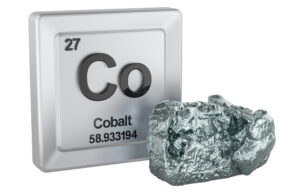
Element Name: Cobalt
Atomic Number: 27
Atomic Mass: 58.933
Atomic Symbol: Co
Melting Point: 1495° C
Boiling Point: 2927° C
Basics:
Cobalt was first discovered in 1730 by Georg Brandt. It was first believed to be a compound of Iron and Arsenic rather than a new element by many chemists. It is a dense and exceptionally hard, lustrous blue metal that is very magnetic. It is located in between Iron and Nickel on the periodic table and shares many physical and chemical properties with them. Cobalt has two allotropes and over 20 isotopes, with Cobalt-59, being the only stable and naturally occurring one.
Interesting Stuff:
During the mining process, many miners died due to toxic vapors that were blamed on goblins. The metal was then named after the German term “Kobald,” which means goblin or evil spirit. When heated, Cobalt turns into a vibrant blue color which has been used as a dye for over 2600 years by many civilizations like the Romans, Egyptians, Iranians, and the Chinese for jewelry, sculptures, and ceramics. Cobalt Aluminate is historically known as Thenard’s blue after its inventor and French Chemist Louis Jacques Thenard. Another well know blue dye is composed of Cobalt Stannate and is known as Cerulean blue.
In the 50’s, breweries encountered a problem with residual detergents used to reduce the amount of foam. To solve this, they started adding Cobalt Sulfate which nullified the detergents’ effects. However, this led to a completely new problem. Heavy drinkers had bad side effects. They were suffering from cardiomyopathy, deafness, nerve damage, tinnitus, thyroid issues, vision problems and, and in extreme cases-death. They had not considered the severe risks the ingestion of large amounts of Cobalt represented. Once this was found the brewers no longer added this to their process and had to find a new additive that did not have any adverse health effects.
Sources:
Cobalt represents 0.001% of Earth’s crust and is extracted from erythrite, skutterudite, and cobaltite in places like, Brazil, Canada, Australia, Zambia, and the Democratic Republic of Congo, which represent most Cobalt-related mineral reserves. Cobalt is mainly produced as a byproduct upon refining Nickel, Lead, and Copper. It can be found along with other transition metals in nodules at the bottom of oceans.
Industrial Uses:
Cobalt is an essential part of rechargeable Lithium batteries in electronics and electric cars. Certain Cobalt alloys are used in jet turbines and gas turbine generators and prosthetic hip and knee replacements. Its salts are used to get brilliant blue paint, porcelain, glass, and pottery as well as to correct mineral deficiencies in animals. Cobalt-60, one of Cobalt’s radioactive isotopes, is used to treat cancer and sometimes to preserve food thanks to its radiations. Cobalt as previously mentioned is magnetic and is thus alloyed with Aluminum and Nickel to make magnets which are 25 times stronger than normal magnets.
Works Cited
Encyclopedia Britannica. (2019). cobalt | Definition & Facts. In Encyclopædia Britannica. https://www.britannica.com/science/cobalt-chemical-element
Royal Society of Chemistry. (2017). Cobalt – Element information, properties and uses | Periodic Table. Rsc.Org. https://periodic-table.rsc.org/element/27/cobalt
Cobalt (Co) | Research Starters | EBSCO Research. (2023). Ebsco. https://www.ebsco.com/research-starters/geology/cobalt-co
Cobalt | Encyclopedia.com. (2019). Encyclopedia.Com. https://www.encyclopedia.com/places/united-states-and-canada/canadian-political-geography/cobalt