

Indium
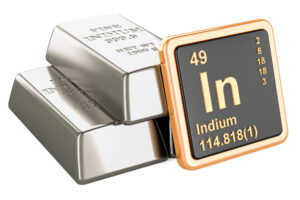
Indium ingots
Element Name: Indium
Atomic Number: 49
Atomic Mass: 114.818 g/mol
Atomic Symbol: In
Melting Point: 156.60 °C
Boiling Point: 2072 °C
Basics:
In 1863, Indium was discovered by Ferdinand Reich in Germany while working on sphalerite, a Zinc mineral. While investigating this material, Ferdinand’s spectroscope showed lines that he believed corresponded to Thallium. However, being color-blind, he asked Hieronymous Richter to look at the spectrum of the isolated element which gave off a brilliant violet line that did not correspond to that of Thallium. The two men worked together and managed to isolate a small sample of the new element and announced its discovery. Indium is a soft, silvery metal that is stable in air and water. It has 39 isotopes, with Indium-113 and Indium-115 being its only two naturally occurring isotopes.
Interesting stuff:
Indium was named after the Latin word “indicum,” meaning violet, due to the bright indigo line that was observed in its spectrum. In 1867, at the World’s fair in Paris, Richter claimed sole credit for finding the new metal, leading to the fall out between the two men that discovered it. Because Indium is one of the most if not the softest and most malleable metal, it can be easily cut with a knife and even bitten. Indium is known to “scream” when bent, similarly to the “cry” of tin. This “scream” is due to crystals twinning in the metal to then realign. This noise that is produced also helps identify the metal’s properties under stress.
Sources:
Indium is one of the least abundant elements on Earth. It is a trace compound typically found in Zinc, Iron, Copper, and Lead ores such as sphalerite and chalcopyrite. There are very few Indium minerals like roquesite that are known and are not abundant enough to be a viable source of Indium. For this reason, Indium is primarily collected as a byproduct during the smelting process (metal extraction using heat). China is the top producer of Indium, followed by South Korea, Japan, and Canada.
Uses:
Indium is mainly used to make Indium Tin Oxide (ITO), a key conductive material used in touch screens, flatscreen TVs and solar panels. Other Indium-containing compounds like Indium Nitride, Phosphide and Antimonide are critical semiconductors used in transistors and high-speed microchips. As mentioned above, Indium is a highly malleable and ductile metal which allows it to be rolled into thin wires and sheets to create gaskets and effective seals to maintain electronic devices integrity. Indalloy 158 is an Indium-containing alloy that has been used in residential and commercial fire-sprinkler systems and has proven to be very useful. For instance, instead of having a melting range, Indalloy 158 has a melting point of 70°C, allowing it to go from solid to liquid at that specific temperature, triggering the sprinkler system. In environments where temperatures are close to absolute zero, Indium remains highly flexible and is thus used to create seals and gaskets in liquid Helium and liquid Hydrogen.
Work Cited
Stewart, D. (2012). Indium. In Chemicool.com. https://www.chemicool.com/elements/indium.html
Indium – Element information, properties and uses | Periodic Table. (n.d.). https://periodic-table.rsc.org/element/49/indium
buy.solder.com. (2026, May 13). Buy 158°F Eutectic Fusible Alloy Bar – 3.75 lbs | Indium. https://buy.solder.com/product/158f-eutectic-fusible-alloy-bar-3-75-lbs/
Pedersen, T. (2018, August 15). Facts about Indium. Live Science. https://www.livescience.com/37352-indium.html