

Samarium
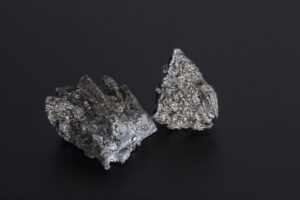
Samarium Metal chunk rare earth element
Element Name: Samarium
Atomic Number: 62
Atomic Mass: 150.336 g/mol
Atomic Symbol: Sm
Melting Point: 1072° C
Boiling Point: 1794° C
Basics:
Discovered and isolated in 1879 by Paul-Émile Lecoq de Boisbaudran. Samarium has a bright silvery-white appearance and a soft texture. It is commonly found in the +3 oxidation state, but its +2 form exists as well, making it a powerful reducing agent. It reacts slowly with Oxygen at room temperature but burns readily when ignited, forming Samarium Oxide. Most of Samarium salts are of a pale-yellow color. Samarium has seven isotopes that each have unique applications.
Interesting Stuff:
Samarium was discovered in the mineral samarskite, which had been named after its discoverer, the Russian mine official Vasili Samarsky-Bykhovets. Thanks to its rare +2 state, Samarium is very valuable in chemical syntheses. Samarium also displays paramagnetic properties at room temperature while showing antiferromagnetic behavior at lower temperatures. In addition, its crystal structure is quite peculiar: under normal conditions, it has a rhomboidal lattice structure while exhibiting structural rearrangements upon changing temperature or pressure conditions due to phase transitions. For these reasons, Samarium is a very valuable element for both physical and chemical applications.
Sources:
Samarium is found in rare earth metals like monazite and bastnäsite and its extraction involves separating it from other rare earth metals. The process typically involves crushing the Samarium-containing minerals before performing solvent extraction and ion-exchange techniques. Finally, Samarium has then to go through refinement to obtain a higher purity level. Important sources of Samarium include the US, Australia, and India, while the most prominent reserves are found in China.
Industrial Uses:
Samarium is commonly used in magnets (Samarium-Cobalt magnets) because of its high heat resistance, allowing the magnets to keep their magnetism. It also has a crucial impact on aircrafts as it improves the performances of alloys by both improving strength and reducing weight. Samarium can also form multiple salts with each specific in various industries. For instance, Samarium Fluoride is commonly used as an enhancer in Calcium Fluoride crystal-based lasers, Samarium Chloride is a very important component for catalyst research, and Samarium Sulfate is used as a primary intermediate for syntheses involving the production of high-purity Samarium metal. As mentioned earlier, Samarium isotopes have different applications. For instance, Samarium-147 is used in geochronology due to its very long half-life to date rocks and minerals. Samarium-149 is used as a control material in nuclear reactors because of its high ability to absorb neutrons. Finally, Samarium-153 is used in radiopharmaceuticals to treat bone cancer.
Works Cited
Gray, T. (2009). The Elements: A Visual Exploration of Every Known Atom in the Universe. Black Dog & Leventhal Publishers.
DaQiang. (n.d.). What is samarium? Explore facts & benefitd | AEM REE. https://www.aemree.com/news/what-is-samarium.html
Samarium – Element information, properties and uses | Periodic Table. (n.d.). https://periodic-table.rsc.org/element/62/samarium
Samarium Elements Facts / Chemistry. (n.d.). https://www.chemicool.com/elements/samarium.html
Samarium: Properties and applications. (n.d.). https://www.stanfordmaterials.com/blog/samarium-properties-and-applications.html