

Terbium
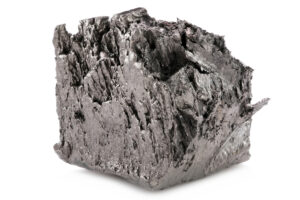
Terbium Metal
Element Name: Terbium
Atomic Number: 65
Atomic Mass: 158.92535
Atomic Symbol: Tb
Melting Point: 1356° C
Boiling Point: 3230° C
Basics:
Terbium is a silvery gray-white rare earth element. It is malleable, ductile, and very soft in its elemental form. It is fairly stable in air. Carl Gustaf Mosander discovered it in 1843 after a strange mineral was found in the mine of the Swedish town Ytterby. The element is named for the town, along with the elements yttrium, ytterbium, and erbium. Terbium has two allotropes (which is switches between at 1289°C) and 26 isotopes. Only one of these isotopes occurs in nature, and that is the only stable form of it (Terbium-159). It is trivalent when forming most compounds, but some exceptions to this rule exist in certain forms of the oxide.
Interesting Facts:
Like Lanthanum, Terbium is soft enough to be cut with a knife at room temperature. Originally, the element which has the pink oxide (which is known today as erbia) was called terbia. The two names were swapped at some point to our modern convention. Terbium, especially when in the compound Terfenol-D, will expand and contract based on an applied magnetic field. This makes it useful in the application of a vibration-based speaker such as the SoundBug. It is a component of powerful magnets, and in particular is used in magnets that need to withstand high temperatures. Along with europium and thulium, terbium is used in anti-counterfeiting marks on Euros. Terbium’s fluorescence makes it useful for finding microbes. It tends to behave like calcium so the microbes will absorb it, thus when placed under UV light unclean areas will glow green.
Sources:
Terbium is never found in an elemental form in nature. It can be found in several minerals, such as bastnasite, cerite, gadolinite, monazite, xenotime, and euxenite. It is particularly rare, as it’s only present in 0.9 parts per million by weight. Like many rare earth elements, China currently has the richest source for terbium. The yttrium-rich clay of southern China is expected to have around 1% terbia (terbium oxide), but there it is not being processed at this time. Thus the most terbium is obtained in the separation of bastnasite.
Industrial Uses:
Terbium sees use as a crystal stabilizer in fuel cells at high temperatures as the compound Sodium terbium borate. In TV tubes, terbium is used as a green phosphor. In fluorescent lighting, terbium green phosphors (which actually produce a bright yellow color when excited) are used in conjunction with divalent and trivalent europium (which are blue and red respectively) to make trichromatic lighting. This is the single largest use of terbium worldwide.
Works Cited
“Facts About Terbium.” Livescience. Livescience.com, 17 July 2013. Web. 26 July 2016.
“Terbium.” Wikipedia. Wikimedia Foundation, n.d. Web. 26 July 2016.
“Terbium Element Facts / Chemistry.” Chemicool. Chemicool.com, 17 Oct. 2012.
Web. 26 July 2016.
Gray, Theodore W., and Nick Mann. The Elements: A Visual Exploration of Every
Known Atom in the Universe. New York: Black Dog & Leventhal, 2009. Print.